From: Anne & Lynn Wheeler <lynn@garlic.com>
Subject: Re: IBM 360 Model 20 Questions
Newsgroups: alt.folklore.computers
Date: Sat, 09 Jun 2007 18:56:52 -0600
ArarghMail706NOSPAM writes:
my q&d translation of gcard ios3270 to html
https://www.garlic.com/~lynn/gcard.html
os/360 call/save/return conventions
https://www.garlic.com/~lynn/gcard.html#50
note that os/360 call/save/return conventions ... have
been extended with the program call and program return
instruction ... mentioned in previous post
https://www.garlic.com/~lynn/2007l.html#71 IBM 360 Model 20 Questions
allowing the call/return to/from routines residing in different virtual address space
5.7 Access-Register Introduction
http://publibz.boulder.ibm.com/cgi-bin/bookmgr_OS390/BOOKS/dz9zr003/5.7?DT=20040504121320
10.34 Program Call
http://publibz.boulder.ibm.com/cgi-bin/bookmgr_OS390/BOOKS/dz9zr003/10.34?DT=20040504121320
10.35 Program Return
http://publibz.boulder.ibm.com/cgi-bin/bookmgr_OS390/BOOKS/dz9zr003/10.35?DT=20040504121320
10.36 Program Transfer
http://publibz.boulder.ibm.com/cgi-bin/bookmgr_OS390/BOOKS/dz9zr003/10.36?DT=20040504121320
10.37 Program Transfer With Instance
http://publibz.boulder.ibm.com/cgi-bin/bookmgr_OS390/BOOKS/dz9zr003/10.37?DT=20040504121320
... in additon there has been hardware support added for a linkage-stack mode of operation:
5.10 Linkage-Stack Introduction
http://publibz.boulder.ibm.com/cgi-bin/bookmgr_OS390/BOOKS/dz9zr003/5.10?DT=20040504121320
5.11 Linkage-Stack Entry-Table Entries
http://publibz.boulder.ibm.com/cgi-bin/bookmgr_OS390/BOOKS/dz9zr003/5.11?DT=20040504121320
5.12 Linkage-Stack Operations.
http://publibz.boulder.ibm.com/cgi-bin/bookmgr_OS390/BOOKS/dz9zr003/5.12?DT=20040504121320
and old posts mentioning ios3270 (browse, fulist, and/or Theo)
https://www.garlic.com/~lynn/96.html#41 IBM 4361 CPU technology
https://www.garlic.com/~lynn/99.html#60 Living legends
https://www.garlic.com/~lynn/99.html#61 Living legends
https://www.garlic.com/~lynn/99.html#108 IBM 9020 computers used by FAA (was Re: EPO stories (was: HELP IT'S HOT!!!!!))
https://www.garlic.com/~lynn/2000b.html#50 VM (not VMS or Virtual Machine, the IBM sort)
https://www.garlic.com/~lynn/2000c.html#76 Is a VAX a mainframe?
https://www.garlic.com/~lynn/2001b.html#83 Z/90, S/390, 370/ESA (slightly off topic)
https://www.garlic.com/~lynn/2001f.html#8 Theo Alkema
https://www.garlic.com/~lynn/2001f.html#9 Theo Alkema
https://www.garlic.com/~lynn/2002e.html#5 What goes into a 3090?
https://www.garlic.com/~lynn/2002i.html#79 Fw: HONE was .. Hercules and System/390 - do we need it?
https://www.garlic.com/~lynn/2002o.html#25 Early computer games
https://www.garlic.com/~lynn/2002p.html#40 Linux paging
https://www.garlic.com/~lynn/2003f.html#20 Alpha performance, why?
https://www.garlic.com/~lynn/2003f.html#32 Alpha performance, why?
https://www.garlic.com/~lynn/2003l.html#12 Why are there few viruses for UNIX/Linux systems?
https://www.garlic.com/~lynn/2004n.html#10 RISCs too close to hardware?
https://www.garlic.com/~lynn/2004q.html#63 creat
https://www.garlic.com/~lynn/2005f.html#14 Where should the type information be: in tags and descriptors
https://www.garlic.com/~lynn/2005t.html#39 FULIST
https://www.garlic.com/~lynn/2005t.html#43 FULIST
https://www.garlic.com/~lynn/2005t.html#45 FULIST
https://www.garlic.com/~lynn/2005t.html#47 What is written on the keys of an ICL Hand Card Punch?
https://www.garlic.com/~lynn/2006.html#0 EREP , sense ... manual
https://www.garlic.com/~lynn/2006.html#15 S/360
https://www.garlic.com/~lynn/2006b.html#2 Mount a tape
https://www.garlic.com/~lynn/2006k.html#50 TSO and more was: PDP-1
https://www.garlic.com/~lynn/2006k.html#51 other cp/cms history
https://www.garlic.com/~lynn/2006l.html#62 Large Computer Rescue
https://www.garlic.com/~lynn/2006m.html#5 Track capacity?
https://www.garlic.com/~lynn/2006m.html#8 Track capacity?
https://www.garlic.com/~lynn/2006m.html#13 Track capacity?
https://www.garlic.com/~lynn/2006n.html#6 Not Your Dad's Mainframe: Little Iron
https://www.garlic.com/~lynn/2006n.html#8 Not Your Dad's Mainframe: Little Iron
https://www.garlic.com/~lynn/2006n.html#19 Improving 360 Addressing
https://www.garlic.com/~lynn/2006n.html#21 The System/360 Model 20 Wasn't As Bad As All That
https://www.garlic.com/~lynn/2006r.html#8 should program call stack grow upward or downwards?
https://www.garlic.com/~lynn/2006r.html#27 A Day For Surprises (Astounding Itanium Tricks)
https://www.garlic.com/~lynn/2006r.html#44 Was FORTRAN buggy?
https://www.garlic.com/~lynn/2006r.html#45 Was FORTRAN buggy?
https://www.garlic.com/~lynn/2006s.html#26 Why these original FORTRAN quirks?
https://www.garlic.com/~lynn/2006s.html#31 Why magnetic drums was/are worse than disks ?
https://www.garlic.com/~lynn/2006s.html#39 Why these original FORTRAN quirks?
https://www.garlic.com/~lynn/2006s.html#46 Why these original FORTRAN quirks?
https://www.garlic.com/~lynn/2006v.html#31 MB to Cyl Conversion
https://www.garlic.com/~lynn/2006x.html#24 IBM sues maker of Intel-based Mainframe clones
https://www.garlic.com/~lynn/2007.html#18 IBM sues maker of Intel-based Mainframe clones
https://www.garlic.com/~lynn/2007b.html#25 What is "command reject" trying to tell me?
https://www.garlic.com/~lynn/2007c.html#45 SVCs
https://www.garlic.com/~lynn/2007e.html#39 FBA rant
https://www.garlic.com/~lynn/2007e.html#64 FBA rant
https://www.garlic.com/~lynn/2007f.html#65 History - Early Green Card
https://www.garlic.com/~lynn/2007f.html#78 What happened to the Teletype Corporation?
https://www.garlic.com/~lynn/2007j.html#5 Even worse than UNIX
https://www.garlic.com/~lynn/2007k.html#25 IBM 360 Model 20 Questions
From: Anne & Lynn Wheeler <lynn@garlic.com>
Subject: Re: nouns and adjectives
Newsgroups: alt.folklore.computers
Date: Sun, 10 Jun 2007 05:42:22 -0600
Morten Reistad <first@last.name> writes:
so internetworking & high-speed networking were disruptive technologies ... the commercial interests were promoting it in the 80s & 90s ... but were really grappling with how to make the transition ... since they had fixed costs & fairly high run rate ... that was supported with lots of usage based charges. they weren't going to see two-order magnitude increase in bit usage ... w/o comparable two-order magnitude drop in usage charges. transition to two-order magnitude increase in bandwidth usage required evolution of bandwidth hungry application ... which wouldn't happen in the high price per bit environment ... so controlled incubator environments were reasonable solution. however, if the best managed ... there were still going to be glitches during distributive technology transition.
in parallel with that, while tcp/ip provided the technology basis for internetworking ... there were some formidable operational and business issues associated with internetworking. i've claimed that NSFNET provided incubator for gestation for bandwidth hungry applications ... but also represented testbed working on various operational issues with respect to internetworking. business issues related to internetworking is totally different domain. The "peering" agreements (different commercial/operational domains interacting thru internetworking) still represent significant issues ... which tend not to spill over into public view ... however even in the past couple yrs there have been incidents where commercial entities have not been able to resolve issue for renewing "peering" agreements ... and there would be situations where bits would no longer be flowing between two specific domains for days or weeks while they resolved their (peering) issues.
The other force going on in this period was whole COTS philosphy. In the 80s and 90s there were starting to be greater and greater push for using COTS ... as being more efficient and cost effective. NSFNET backbone was much more of a temporary technology incubator ... which then had to transition to COTS ... that once the major issues were worked out ... use of COTS facilities would be much more cost effective for gov. operations than custom, non-COTS operation. Thru the 80s and 90s, congress passed various legislation promoting COTS as well as pushing gov. originated technology into commercial envirornment (commercializing the technology to make the technology more efficient as well as accelerating commercial environments ability to be more competitive). Some of this came under the heading of "technology re-use" bills ... pushing gov. invented technology into the commercial arena. Some of the technology re-use bills also involved relazing some of the anti-trust provisions when there was to be cooperating commercial interests involving use of gov. invented technology.
for slightly other drift, one of the other areas COTS was involved
starting in the late 70s and early 80s was the (gov) update of SGML for
documents ... recent x-over involving subject of SGML (markup languages)
and self describing data
https://www.garlic.com/~lynn/aadsm27.htm#24 Why self describing data formats:
https://www.garlic.com/~lynn/aadsm27.htm#25 Why self describing data formats:
misc. past posts mentioning the whole gov. involvement/promotion of COTS,
technology re-use, disruptive technologies
https://www.garlic.com/~lynn/98.html#40 Comparison Cluster vs SMP?
https://www.garlic.com/~lynn/2000f.html#44 Al Gore and the Internet (Part 2 of 2)
https://www.garlic.com/~lynn/2001c.html#32 How Commercial-Off-The-Shelf Systems make society vulnerable
https://www.garlic.com/~lynn/2001c.html#38 How Commercial-Off-The-Shelf Systems make society vulnerable
https://www.garlic.com/~lynn/2002h.html#80 Al Gore and the Internet
https://www.garlic.com/~lynn/2002h.html#82 Al Gore and the Internet
https://www.garlic.com/~lynn/2002l.html#15 Large Banking is the only chance for Mainframe
https://www.garlic.com/~lynn/2002p.html#6 unix permissions
https://www.garlic.com/~lynn/2003n.html#26 Good news for SPARC
https://www.garlic.com/~lynn/2004o.html#51 Integer types for 128-bit addressing
https://www.garlic.com/~lynn/2005d.html#20 shared memory programming on distributed memory model?
https://www.garlic.com/~lynn/2005e.html#15 Device and channel
https://www.garlic.com/~lynn/2006c.html#40 IBM 610 workstation computer
https://www.garlic.com/~lynn/2006s.html#63 Microsoft to design its own CPUs - Next Xbox In Development
https://www.garlic.com/~lynn/2006u.html#14 Year-end computer bug could ground Shuttle
https://www.garlic.com/~lynn/2006u.html#35 Friday fun - Discovery on the pad and the software's not done
https://www.garlic.com/~lynn/2007j.html#16 Newbie question on table design
https://www.garlic.com/~lynn/2007l.html#57 How would a relational operating system look like?
From: Anne & Lynn Wheeler <lynn@garlic.com>
Subject: Re: John W. Backus, 82, Fortran developer, dies
Newsgroups: alt.folklore.computers
Date: Sun, 10 Jun 2007 06:07:45 -0600
Steve O'Hara-Smith <steveo@eircom.net> writes:
some of the issues now is that (at least with synchronous clocks and other issues) it is getting harder and harder to make single chips operate at higher & higher frequency (limits of elapsed time for signal to span physical distance from one side of chip to another ... also discontinuity between speed that chip operates at and latency to get data out of memory chips).
so the current direction is to increase computing thruput by going to multiple (independent) cores on the same chip ... this can be used to emulate multiprocessor, multi-chip operation ... especially if there are multiple independent tasks to keep the different chips busy. however, in personal computers with increasingly complex applications ... the single application thruput will no longer see improved thruput. this is starting to increase pressure on complex applications to move to multi-thread/parallel execution ... to be able to obtained increased thruput from the multiple, independent cores. This is much more than the operating system dispatcher/scheduler being able to efficiently multitask independent applications (whether they are working in single processor/core or multiprocessor/multicore environment).
recent post with mention of story where Intel's Pat Gelsinger had to
explain this to Gates:
https://www.garlic.com/~lynn/2007i.html#78 John W. Backus, 82, Fortran developer, dies
recent post mentioning news item that future generations of windows
will be redone for multi-core operation
https://www.garlic.com/~lynn/2007l.html#38 Is Parallel Programming Just Too Hard?
other recent posts about the "disruptive" parallel/multi-core technology
https://www.garlic.com/~lynn/2007.html#3 The Future of CPUs: What's After Multi-Core?
https://www.garlic.com/~lynn/2007.html#9 "The Elements of Programming Style"
https://www.garlic.com/~lynn/2007.html#29 Just another example of mainframe costs
https://www.garlic.com/~lynn/2007.html#30 V2X2 vs. Shark (SnapShot v. FlashCopy)
https://www.garlic.com/~lynn/2007.html#31 V2X2 vs. Shark (SnapShot v. FlashCopy)
https://www.garlic.com/~lynn/2007b.html#16 V2X2 vs. Shark (SnapShot v. FlashCopy)
https://www.garlic.com/~lynn/2007b.html#44 Why so little parallelism?
https://www.garlic.com/~lynn/2007b.html#57 "The Elements of Programming Style"
https://www.garlic.com/~lynn/2007c.html#21 How many 36-bit Unix ports in the old days?
https://www.garlic.com/~lynn/2007c.html#24 "The Elements of Programming Style"
https://www.garlic.com/~lynn/2007c.html#42 Keep VM 24X7 365 days
https://www.garlic.com/~lynn/2007d.html#13 Why so little parallelism?
https://www.garlic.com/~lynn/2007d.html#28 SVCs
https://www.garlic.com/~lynn/2007d.html#39 old tapes
https://www.garlic.com/~lynn/2007f.html#10 Beyond multicore
https://www.garlic.com/~lynn/2007g.html#3 University rank of Computer Architecture
https://www.garlic.com/~lynn/2007g.html#23 The Perfect Computer - 36 bits?
https://www.garlic.com/~lynn/2007g.html#57 IBM to the PCM market(the sky is falling!!!the sky is falling!!)
https://www.garlic.com/~lynn/2007h.html#9 21st Century ISA goals?
https://www.garlic.com/~lynn/2007h.html#34 GA24-3639
https://www.garlic.com/~lynn/2007h.html#40 sizeof() was: The Perfect Computer - 36 bits?
https://www.garlic.com/~lynn/2007h.html#52 ANN: Microsoft goes Open Source
https://www.garlic.com/~lynn/2007i.html#20 Does anyone know of a documented case of VM being penetrated by hackers?
https://www.garlic.com/~lynn/2007i.html#36 John W. Backus, 82, Fortran developer, dies
https://www.garlic.com/~lynn/2007i.html#66 John W. Backus, 82, Fortran developer, dies
https://www.garlic.com/~lynn/2007i.html#67 John W. Backus, 82, Fortran developer, dies
https://www.garlic.com/~lynn/2007j.html#30 John W. Backus, 82, Fortran developer, dies
https://www.garlic.com/~lynn/2007j.html#84 VLIW pre-history
https://www.garlic.com/~lynn/2007j.html#95 VLIW pre-history
https://www.garlic.com/~lynn/2007j.html#96 VLIW pre-history
https://www.garlic.com/~lynn/2007j.html#97 VLIW pre-history
https://www.garlic.com/~lynn/2007k.html#6 VLIW pre-history
https://www.garlic.com/~lynn/2007k.html#16 John W. Backus, 82, Fortran developer, dies
https://www.garlic.com/~lynn/2007k.html#23 Another "migration" from the mainframe
https://www.garlic.com/~lynn/2007k.html#33 Even worse than UNIX
https://www.garlic.com/~lynn/2007k.html#38 John W. Backus, 82, Fortran developer, dies
https://www.garlic.com/~lynn/2007l.html#15 John W. Backus, 82, Fortran developer, dies
https://www.garlic.com/~lynn/2007l.html#19 John W. Backus, 82, Fortran developer, dies
https://www.garlic.com/~lynn/2007l.html#24 Is Parallel Programming Just Too Hard?
https://www.garlic.com/~lynn/2007l.html#25 Computer tube production years
https://www.garlic.com/~lynn/2007l.html#26 Is Parallel Programming Just Too Hard?
https://www.garlic.com/~lynn/2007l.html#34 Is Parallel Programming Just Too Hard?
https://www.garlic.com/~lynn/2007l.html#42 My Dream PC -- Chip-Based
https://www.garlic.com/~lynn/2007l.html#49 Drums: Memory or Peripheral?
https://www.garlic.com/~lynn/2007l.html#52 Drums: Memory or Peripheral?
https://www.garlic.com/~lynn/2007l.html#60 Is Parallel Programming Just Too Hard?
https://www.garlic.com/~lynn/2007l.html#63 Is Parallel Programming Just Too Hard?
From: Anne & Lynn Wheeler <lynn@garlic.com>
Subject: Re: nouns and adjectives
Newsgroups: alt.folklore.computers
Date: Sun, 10 Jun 2007 06:15:02 -0600
jmfbahciv writes:
this is where some of the current major application product offerings didn't actually come out of vendor development shops ... but (development) originated in some customer shop ... and was only later transferred to some vendor development group (and I would joke that development groups weren't actually responsible for the original development ... but were more like maintenance organizations that were responsible for possible +/- five percent change per annum).
The explosion of personal computers in the 80s ... saw an explosion in the number of (customer/end-user) invented new applications. There was a similar period in the late 60s and early 70s ... associated with the (relative) explosion in the number of (360) computers being used by customers ... and corresponding increase in new/different applications.
From: Anne & Lynn Wheeler <lynn@garlic.com>
Subject: Re: Zork and Adventure
Newsgroups: alt.folklore.computers
Date: Sun, 10 Jun 2007 06:26:24 -0600
jmfbahciv writes:
the copy of (CMS) ADVENT from tymshare (which had ported the fortran from pdp10 ... that they had gotten from a stanford machine ... and ported to vm370) ... had a restriction ... game was limited to 100 moves first shift ... unless you had the secret password.
i started distributing ADVENT executable on the internal network ... and would offer anybody that finished (obtained 300pts) the source.
a couple old emails mentioning getting advent copy
https://www.garlic.com/~lynn/2006y.html#email780405
https://www.garlic.com/~lynn/2006y.html#email780405b
from this old post (with numerous other advent references)
https://www.garlic.com/~lynn/2006y.html#18 The History of Computer Role-Playing Games
From: Anne & Lynn Wheeler <lynn@garlic.com>
Subject: Re: Is Parallel Programming Just Too Hard?
Newsgroups: bit.listserv.ibm-main,alt.folklore.computers
Date: Sun, 10 Jun 2007 06:33:18 -0600
jmfbahciv writes:
From: Anne & Lynn Wheeler <lynn@garlic.com>
Subject: Re: Zork and Adventure
Newsgroups: alt.folklore.computers
Date: Sun, 10 Jun 2007 07:02:50 -0600
Anne & Lynn Wheeler <lynn@garlic.com> writes:
random other refs ... from long ago and far away
Date: 04/14/78 09:39:55
To: wheeler
From: someplace in the UK

hi.
do you know how to work out the second key to be allowed onto
adventur as a wizard ?
    the first key is grate
the second key seems to be based on a formaula something like

do i=1 to 5 by 1;
.. = mod(..,5)+1;
.. = mod(..,10)-abs(array(..)-array(mod(..+1,5)+1))*mod(..,10)
         k  = mod(..,26)+1;
pswd(j) = abet(k);
         j = j + 1;
end;

that's as for as i got.
... snip ... top of post, old email index
Date: 05/17/78 10:12:22
To: wheeler
From: someplace on the east coast

Lynn --
I've picked up a version of the source to ADVENTUR.
This version appears to be slightly older than the module,
and was converted from FORTRAN to PL/I.
You will be getting 4 files:
RANDU FORTRAN
ITIME ASSEMBLE
CAVES FILE
ADVENT PLIOPT
The last 2 files are huffed with the garble option.
The encryption key used was 'afs' (note --- lower case!!).
Enjoy.
&1 &2 ADVENTUR MODULE D1()V 65535 5 40 4/11/78 19:59... snip ...
From: Anne & Lynn Wheeler <lynn@garlic.com>
Subject: Re: nouns and adjectives
Newsgroups: alt.folklore.computers
Date: Sun, 10 Jun 2007 07:53:51 -0600
Anne & Lynn Wheeler <lynn@garlic.com> writes:
a couple past posts mentioning problems/issues cropping up
with peering agreements (raising possibility of internet
partitioning)
https://www.garlic.com/~lynn/2001m.html#28 Internet like city w/o traffic rules, traffic signs, traffic lights and traffic enforcement
https://www.garlic.com/~lynn/2005r.html#32 How does the internet really look like ?
https://www.garlic.com/~lynn/2005t.html#4 Privacy issue - how to spoof/hide IP when accessing email / usenet servers ?
and with respect to wild, wild west reference in one of the above posts ... recent reference to traffic controls:
Time Warner Cable Implements Packet Shaping
http://slashdot.org/articles/07/06/10/0645232.shtml
TIME WARNER ANNOUNCES INTRODUCTION OF PACKET SHAPING TECHNOLOGY NATIONWIDE
http://www.dslreports.com/forum/remark,18468495
From: Anne & Lynn Wheeler <lynn@garlic.com>
Subject: Re: John W. Backus, 82, Fortran developer, dies
Newsgroups: alt.folklore.computers
Date: Sun, 10 Jun 2007 11:47:13 -0600
Brian Inglis <Brian.Inglis@SystematicSW.Invalid> writes:
i do somewhat the above with script that does wget for 40-some different URLs and then checks for differences between the previous and the current. "new" URLs (that appear on the pages) are then fired off to be loaded in browser tabs (sometimes may be a couple hundred). cycling thru the tabs (locally) is lot faster than clicking and waiting for each to load, one at a time, sequentially.
there is a little heuristics needed here since some sites look for too many gets coming too close together from the same ip-address. however, it is possible to spread these out between gets for other servers tabs that have already loaded (this does require some coordination since multiple different origin sites can have URLs pointing to the same destination site). ... the gets are also running in the background ... so can be looking at browser tabs in the foreground while other tabs are still loading in the background.
i can delete the tabs/pages that aren't interesting and then do tab-all
bookmark of the rest. then extract the bookmark URLs for other purposes
... somewhat alluded to in this post
https://www.garlic.com/~lynn/2007l.html#30 tab browsing
next on wish list is browser that is really multi-threaded that can take advantage of multi-core aka different tabs are somewhat multi-threaded ... but managed within the browser task ... so only takes advantage of single processor ... things can get a little sluggish over hundred or so tabs especially while still loading ... which additional processors would help.
From: Anne & Lynn Wheeler <lynn@garlic.com>
Subject: Re: John W. Backus, 82, Fortran developer, dies
Newsgroups: alt.folklore.computers
Date: Sun, 10 Jun 2007 14:22:12 -0600
Roland Hutchinson <my.spamtrap@verizon.net> writes:
in the e-commerce specific scenario ... a couple recent references/posts
https://www.garlic.com/~lynn/2007l.html#35 My Dream PC -- Chip-Based
https://www.garlic.com/~lynn/2007l.html#68 nouns and adjectives
SSL is somewhat session oriented that is used to "hide" (encrypt) the sensitive information (credit card number, other transaction details), while being transmitted over the internet ... but otherwise leaves the transaction information (naked &) vulnerable thru the whole rest of the numerous business processes.
the x9.59 financial standards process "armors" (authentication plus
integrity) the actual transaction ... so that it (and the related
information) is "protected" for the complete lifetime that the
transaction (& related information) may continue to exist.
https://www.garlic.com/~lynn/x959.html#x959
From: Anne & Lynn Wheeler <lynn@garlic.com>
Subject: Re: John W. Backus, 82, Fortran developer, dies
Newsgroups: alt.folklore.computers
Date: Sun, 10 Jun 2007 15:40:07 -0600
Anne & Lynn Wheeler <lynn@garlic.com> writes:
trivial makefile ...
urls := $(shell cat urllist.txt)

.PHONY: RUP $(urls)
RUP: $(urls)
$(urls):
        wgetlist.sh $@
...
invoke make with -j specifying the above make file; urllist.txt contains a list of URLs ... with no parameter for -j ... it will fire off wgetlist.sh for each of the URLs and waits for them all to finish. something like "-j 10" will only keep a max of ten going concurrently.
From: Anne & Lynn Wheeler <lynn@garlic.com>
Subject: Re: John W. Backus, 82, Fortran developer, dies
Newsgroups: alt.folklore.computers
Date: Sun, 10 Jun 2007 22:40:55 -0600
Brian Inglis <Brian.Inglis@SystematicSW.Invalid> writes:
this was used to implement 370 virtual machines in cp67 (running on 360/67). 370 virtual memory hardware defintion didn't exactly match 360/67 ... and there were some new 370 instructions that didn't exist in 360.
370 virtual machine support was operational and running on regular basis a yr befor 370 hardware was operational.
a few recent posts mentioning cp67 l, h, and i "level" updates
https://www.garlic.com/~lynn/2007b.html#20 How many 36-bit Unix ports in the old days?
https://www.garlic.com/~lynn/2007f.html#12 FBA rant
https://www.garlic.com/~lynn/2007i.html#16 when was MMU virtualization first considered practical?
that effort also involved some amount of distributed development between
endicott (where the hardware was being built) and cambridge science
center ... with network link for exchanging files ... misc. past posts
mentioning internal network
https://www.garlic.com/~lynn/subnetwork.html#internalnet
the support for multiple level source update was also developed in that
period ... supporting the different kernel source "levels". a few recent
posts on cms multi-level source update
https://www.garlic.com/~lynn/2007f.html#12 FBA rant
https://www.garlic.com/~lynn/2007k.html#33 Even worse than UNIX
From: Anne & Lynn Wheeler <lynn@garlic.com>
Subject: Re: Buying a used desktop PC?
Newsgroups: alt.folklore.computers
Date: Mon, 11 Jun 2007 06:32:59 -0600
krw <krw@att.bizzzz> writes:
Fed Proposes Tighter Controls On Credit Card Rates;
Congress Considers Bills to Curb Abusive Practices
http://www.consumeraffairs.com/news04/2007/05/fed_credit_cards.html
Are Consumers Kicking the Credit Card Habit?
http://www.consumeraffairs.com/news04/2007/06/credit_hooked.html
From: Anne & Lynn Wheeler <lynn@garlic.com>
Subject: Re: Is Parallel Programming Just Too Hard?
Newsgroups: bit.listserv.ibm-main,alt.folklore.computers
Date: Mon, 11 Jun 2007 07:21:06 -0600
krw <krw@att.bizzzz> writes:
however, at the time they were working on 256-way numa implemention (NUMA-Q, with intel processors) done with SCI
... we had been involved in some of the SCI stuff
https://en.wikipedia.org/wiki/Scalable_Coherent_Interconnect
at the same time we were involved with some of the FCS ... and also
working on ha/cmp scale-up ... old ha/cmp posts
https://www.garlic.com/~lynn/subtopic.html#hacmp
and some old email about ha/medusa scale-up
https://www.garlic.com/~lynn/lhwemail.html#medusa
in the same time frame we were dealing with sequent, we also spent
some amount of time talking to convex which were doing SCI-based
128-system exemplar using pa/risc chip
https://en.wikipedia.org/wiki/Convex_Computer
somewhat as an aside, the wiki sequent article notes that after ibm bought sequent ... nearly all vestiges of sequent technology has disappeared, except for possibly some stuff contributed to linux.
past posts mentioning smp, tightly-coupled, and/or compare&swap
instruction
https://www.garlic.com/~lynn/subtopic.html#smp
for other drift, ibm also bought informix
https://en.wikipedia.org/wiki/Informix
when we were doing ha/cmp ... we spent some amount of time with
ingres, sybase, informix ... as well as oracle ... old post reference
https://www.garlic.com/~lynn/95.html#13
https://www.garlic.com/~lynn/95.html#15
and informix had been doing quite a bit of working tuning informix on (multiprocessor) sequent platforms (somewhat referenced in wiki article) ... in fact, most of the informix people we dealt with were in their portland location (near sequent's beaverton location)
for additional drift ... lots of posts about RDBMS and/or original
relational/sql implementation
https://www.garlic.com/~lynn/submain.html#systemr
past posts in this thread:
https://www.garlic.com/~lynn/2007l.html#24 Is Parallel Programming Just Too Hard?
https://www.garlic.com/~lynn/2007l.html#26 Is Parallel Programming Just Too Hard?
https://www.garlic.com/~lynn/2007l.html#34 Is Parallel Programming Just Too Hard?
https://www.garlic.com/~lynn/2007l.html#38 Is Parallel Programming Just Too Hard?
https://www.garlic.com/~lynn/2007l.html#60 Is Parallel Programming Just Too Hard?
https://www.garlic.com/~lynn/2007l.html#63 Is Parallel Programming Just Too Hard?
https://www.garlic.com/~lynn/2007m.html#5 Is Parallel Programming Just Too Hard?
From: Anne & Lynn Wheeler <lynn@garlic.com>
Subject: Re: Is Parallel Programming Just Too Hard?
Newsgroups: bit.listserv.ibm-main,alt.folklore.computers
Date: Mon, 11 Jun 2007 09:16:36 -0600
jmfbahciv writes:
multi-threading has tended to be associated w/application (or at least non-kernel) programming ... but most have tended to be relatively specialized implementions ... like DBMS ... not necessarily general applications (in the mainframe world, some of it was in subsystems that were doing their own multitasking implementations ... to compensate for the native operating system deficiencies ... from 60s ... stuff like CICS and apl\360).
while charlie had invented compare&swap at the science center as part of cp67 multiprocessing fine-grain locking support ... justifying the instruction for 370 required coming up with uses other than kernel multiprocessing support. the result was the description for its use by application (or at least non-kernel) multi-threaded operation. Previously, multi-threaded applications tended to require kernel calls to safely serialize/coordinate the different application threads. Compare&swap instruction allowed some of that to now be implemented "in-line" and avoid the overhead of the kernel calls ... and worked the same, whether the application multi-threading was executing in a non-multiprocessor environment or in a multiprocessor/tightly-coupled environment.
description was written up and appeared in the 370 principles of
operation ... version in more recent principles of operation
http://publibz.boulder.ibm.com/cgi-bin/bookmgr_OS390/BOOKS/dz9zr003/A.6?DT=20040504121320
reference in early post in this thread
https://www.garlic.com/~lynn/2007l.html#63 Is Parallel Programming Just Too Hard?
lots of past posts mentioning multiprocessing, tighly-coupled, and/or
compare&swap instruction
https://www.garlic.com/~lynn/subtopic.html#smp
From: Anne & Lynn Wheeler <lynn@garlic.com>
Subject: Re: Patents, Copyrights, Profits, Flex and Hercules
Newsgroups: bit.listserv.ibm-main,alt.folklore.computers
Date: Mon, 11 Jun 2007 12:04:54 -0600
oscarptyltd@ibm-main.lst (Clem Clarke) writes:
that in the 60s and much of the 70s ... lots of the innovation came out of customer installations & datacenters ... since it was the customers that understood the need and requirement ... things like cics, ims, etc. later they were transferred to "development" organizations for product support. in many cases, this is misnomer ... since those "development" organizations are responsible for product maintenance ... not the products "development" (maybe doing plus/minus five percent changes per annum). I've periodically made facetious comments referencing the "term" inflation in using the word "development" applied to organizations that are primarily product "maintenance".
something similar happened with the introduction of the ibm/pc ... large proportion of the "products" originated from end-users (that were faced with the actual problems and understood what kind of solution was needed). vendor product operations tend to have people like software engineers that understand issues about software maintenance ... but rarely have people with the necessary experience that they could see what solution was originally needed.
even before ibm/pc came out ... there were some that had jump shipped from vm/cms (that had been providing mainframe-based personal computing environment) and were implementing some number of CMS applications on other early personal computers. These weren't ports of CMS applications (because the implementation details tended to be totally different), but frequently the look&feel and the solution they provided were the same.
the "OCO-wars" were especially hard on the vm/cms community ... because not only was full source available ... but even maintenance, fixes, etc for customers were shipped as source updates ... based on CMS multi-level source maintenance facilities. Some studies from their period even claimed the number of system (source) updates done at customer datacenters (aka aggregate lines-of-code) was actually larger than the source lines-of-code in the base system.
the high-end of the market is where the (quarterly) revenue/profit ... but all the innovation tends to originate at the low-end & mid-range ... in part innovation requires quite a bit of experimentation, trial&error, etc ... and the high-end is rarely made available for such experimentation.
As a result, some of the other vendors found a need that could filled in the entry/low-end market segment (and long term ... it is frequently the entry/low-end that tends to feed the high-end with the applications that keep the high-end quarterly revenue sustained).
the pre-occupation with quarterly results has been a sporadic topic for
at least the last 40 yrs. during periods when there was significant
general economic growth ... the generational issues appeared to almost
take care of themselves ... allowing the perception that executives
could solely concentrate on the quarterly issues. however, this approach
somewhat came to roost. i've mentioned before about being at a talk at
MIT in the early 70s where Amdahl was asked how he was able to convince
the money people to support his new clone computer company. His reply
was that there was already something like $200b that customers had
invested in 360 applications ... that even if IBM were to totally walk
away from 360/370 ... which might be considered a veiled reference to
the future system project
https://www.garlic.com/~lynn/submain.html#futuresys
... (just) that (existing) software application base could keep him in business thru the end of the century.
starting in the early 70s, i had been heavily involved with HONE
deployment ... first its original objective to provied "hands-on"
environment to branch office SEs with operating systems running in
virtual machines ... and then the transition to being primarily an
online, interactive environment deploying applications (mostly
implemented in cms\apl) supporting sales & marketing worldwide.
https://www.garlic.com/~lynn/subtopic.html#hone
in the mid-70s, I got con'ed into helping with the virgil/tully
microcode assists ... including spending time off & on over a period of
a year running around the world with the product managers, meeting with
business planning & forecasting groups positioning the processors in the
market. One of the things that I saw was that the business positioning
environment in world trade was somewhat the early stages of what was
going to be happing in the domestic market a decade or so later (the
HONE tools somewhat gave me perspective of what sales & marketing was
doing world-wide ... from the mechanics bottom-up ... where-as all the
virgil/tully forecasting was perspective of sales & marketing somewhat
from top-down). lots of past posts talking about (both) 360 & 370
microcode:
https://www.garlic.com/~lynn/submain.html#mcode
From: Anne & Lynn Wheeler <lynn@garlic.com>
Subject: Re: Can individual TCP packets travel along different route or ... ?
Newsgroups: comp.protocols.tcp-ip
Date: Mon, 11 Jun 2007 19:11:08 -0600
"robertwessel2@yahoo.com" <robertwessel2@yahoo.com> writes:
some of the discussion found in rfc721 ... rfc721 summary from my RFC index
https://www.garlic.com/~lynn/rfcidx2.htm#721
as usual ... clicking on the ".txt=nnnn" field (in the rfc summary) retrieves the actual RFC.
From: Anne & Lynn Wheeler <lynn@garlic.com>
Subject: Re: Scholars needed to build a computer history bibliography
Newsgroups: alt.folklore.computers
Date: Mon, 11 Jun 2007 21:17:14 -0600
krw <krw@att.bizzzz> writes:
on one trip back with the family ... at one point was out in the outhouse ... and my daughter was waiting outside for me to leave ... she slipped in as i exited ... and automatically i turned the block of wood (locking her in) as the door shut ... w/o even thinking about it consciously. 30-40 mins later ... somebody asked where she was ... and found her inside banging and yelling (couldn't hear her from the house).
From: Anne & Lynn Wheeler <lynn@garlic.com>
Subject: Re: Scholars needed to build a computer history bibliography
Newsgroups: alt.folklore.computers
Date: Mon, 11 Jun 2007 22:27:05 -0600
re:
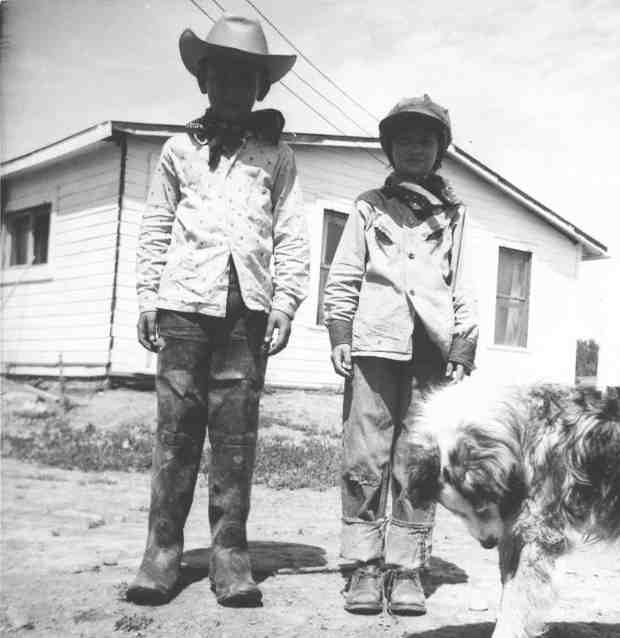
my (younger) brother recently sent me a scanned jpg of old photo when
i was 8yrs old ... shows me in high rubber boots (younger cousin
is next to me in picture)
https://www.garlic.com/~lynn/lynnat8.jpg
i had been out in the field moving irrigation sprinkler pipe ... 3in diameter aluminum ... each section something like 20ft long.
the house was on bank of small river which would nearly dry up by late summer ... but earlier in the yr could get enough water to irrigate around 10acres of alfalfa.
if the ground had just the right amount of moisture ... the mud would really clump ... getting possibly 10lbs on each boot ... at which time, i remember finding it easier to take off the boots and go barefoot.
Farming in the 1950s & 60s
http://www.livinghistoryfarm.org/farminginthe50s/water_03.html
from above:
In June 1976, Scientific American magazine called center pivot
irrigation systems "perhaps the most significant mechanical innovation
in agriculture since the replacement of draft animals by the tractor."
... snip ...
aka before that ... the irrigation pipes had to be manually moved and placed.
hard to find old pictures of the sprinklers and pipe ... did find
this pdf file with b&w picture on page 3
http://www.math.washington.edu/~morrow/mcm/uw21_06.pdf
tracks back to original here:
http://www.ers.usda.gov/Briefing/WaterUse/Images/handline2.jpg
From: Anne & Lynn Wheeler <lynn@garlic.com>
Subject: Re: Is Parallel Programming Just Too Hard?
Newsgroups: bit.listserv.ibm-main,alt.folklore.computers
Date: Tue, 12 Jun 2007 09:28:50 -0600
Greg Menke <gdmnews@toadmail.com> writes:
it is a simplification of the common implementation in the 60s & 70s (and frequently well thru the 80s) of a single kernel "spin-lock" ... where the first thing that happened on entry into the kernel was to "spin" on a single lock ... until it was obtained (serializing all kernel operations, effectively kernel almost operated as if there was only a single processor, avoided having to resolve many of the concurrency issues).
for some vendors ... getting reasonably highly parallel operation and support was long difficult road ... and didn't come immediately and/or easily. if some of the highly experienced/skilled kernel developers could take decades to supporting highly parallel ... it might be understandable that it would take application developers a couple decades once they get around to it.
i.e. old email discussion/announcement of VMS symmetric
multiprocessing support in 1988
https://www.garlic.com/~lynn/2007.html#email880324
https://www.garlic.com/~lynn/2007.html#email880329
in this post:
https://www.garlic.com/~lynn/2007.html#46 How many 36-bit Unix ports in the old days?
i.e. VMS symmetric multiprocessing support was nearly two decades after charlie originally invented compare&swap instruction for fine-grain cp67 multiprocessing locking ... and the whole stuff put together how application programs could use it for multi-threaded operation (independent of whether it was running in single processor environment or multiprocessor environment).
past posts in this thread
https://www.garlic.com/~lynn/2007l.html#24 Is Parallel Programming Just Too Hard?
https://www.garlic.com/~lynn/2007l.html#26 Is Parallel Programming Just Too Hard?
https://www.garlic.com/~lynn/2007l.html#34 Is Parallel Programming Just Too Hard?
https://www.garlic.com/~lynn/2007l.html#38 Is Parallel Programming Just Too Hard?
https://www.garlic.com/~lynn/2007l.html#60 Is Parallel Programming Just Too Hard?
https://www.garlic.com/~lynn/2007l.html#63 Is Parallel Programming Just Too Hard?
https://www.garlic.com/~lynn/2007m.html#5 Is Parallel Programming Just Too Hard?
https://www.garlic.com/~lynn/2007m.html#13 Is Parallel Programming Just Too Hard?
https://www.garlic.com/~lynn/2007m.html#14 Is Parallel Programming Just Too Hard?
From: Anne & Lynn Wheeler <lynn@garlic.com>
Subject: Re: Patents, Copyrights, Profits, Flex and Hercules
Newsgroups: bit.listserv.ibm-main,alt.folklore.computers
Date: Tue, 12 Jun 2007 09:45:05 -0600
R.Skorupka@ibm-main.lst (R.S.) writes:
slightly related recent posts about looking at software piracy (DRM) in
the mainframe and PC market space
https://www.garlic.com/~lynn/2007b.html#59 Peter Gutmann Rips Windows Vista Content Protection
https://www.garlic.com/~lynn/aadsm27.htm#9 Enterprise Right Management vs. Traditional Encryption Tools
old email about "new" apple lisa announcement and conjecture about the
processor serial number being used for software licensing (and
piracy countermeasure).
https://www.garlic.com/~lynn/2007b.html#email830213
https://www.garlic.com/~lynn/2007b.html#email830213b
in this recent post
https://www.garlic.com/~lynn/2007b.html#56 old lisa info
part of the mainframe was being able to show in court that something out of the ordinary had to have been done to subvert the licensing provisions (value was worth taking to court). in the PC case, the value of individual copy makes it difficult to justify investigation and bringing to court every individual case.
TPM is the one of the latest in piracy countermeasure (as well as
suppose to be countermeasure to software compromises). misc. past
posts mentioning giving an assurance talk in trusted computing track
at intel developers conference
https://www.garlic.com/~lynn/aadsm5.htm#asrn1 Assurance, e-commerce, and some x9.59
https://www.garlic.com/~lynn/aadsm21.htm#3 Is there any future for smartcards?
https://www.garlic.com/~lynn/aadsm23.htm#56 UK Detects Chip-And-PIN Security Flaw
https://www.garlic.com/~lynn/aadsm24.htm#23 Use of TPM chip for RNG?
https://www.garlic.com/~lynn/aadsm24.htm#52 Crypto to defend chip IP: snake oil or good idea?
https://www.garlic.com/~lynn/2005g.html#36 Maximum RAM and ROM for smartcards
https://www.garlic.com/~lynn/2005o.html#3 The Chinese MD5 attack
https://www.garlic.com/~lynn/2006p.html#48 Device Authentication - The answer to attacks lauched using stolen passwords?
https://www.garlic.com/~lynn/2006w.html#37 What does a patent do that copyright does not?
https://www.garlic.com/~lynn/2007g.html#61 The Perfect Computer - 36 bits?
https://www.garlic.com/~lynn/2007g.html#63 The Perfect Computer - 36 bits?
https://www.garlic.com/~lynn/2007l.html#42 My Dream PC -- Chip-Based
From: Anne & Lynn Wheeler <lynn@garlic.com>
Subject: Re: Scholars needed to build a computer history bibliography
Newsgroups: alt.folklore.computers
Date: Tue, 12 Jun 2007 10:51:12 -0600
Peter Flass <Peter_Flass@Yahoo.com> writes:
old cresent/mapleine reference:
http://www.historylink.org/essays/output.cfm?file_id=2006
from above:
Mapleine was the company's signature product for much of the twentieth
century. Cash-strapped housewives used it as a substitute for maple
syrup during the Depression of the 1930s, and it remained popular with
cooks and bakers for decades. It was also used as a flavoring agent in
commercial cigarette manufacturing. Crescent promoted Mapleine and other
products by publishing small cookbooks, with titles such as Mapleine
Dainties: How to Make Them, A Guide to Spices: How to Buy Them, Store
Them, Use Them, and Pickles and Relishes.
... snip ...
re:
https://www.garlic.com/~lynn/2007m.html#17 Scholars needed to build a computer history bibliography
https://www.garlic.com/~lynn/2007m.html#18 Scholars needed to build a computer history bibliography
slightly related previous thread:
https://www.garlic.com/~lynn/2007g.html#79 Working while young
other drift here:
https://www.garlic.com/~lynn/2006w.html#51 Year-end computer bug could ground Shuttle
From: Anne & Lynn Wheeler <lynn@garlic.com>
Subject: Re: Is Parallel Programming Just Too Hard?
Newsgroups: bit.listserv.ibm-main,alt.folklore.computers
Date: Tue, 12 Jun 2007 21:38:25 -0600
scott@slp53.sl.home (Scott Lurndal) writes:
as an aside, in the 370 attached processor scenario ... most of the kernel implementations was fully symmetrical kernel operation in all respects ... except when it came to actually initiating an operation ... and the kernel would check if the current processor had the specific attached channels ... and if necessary create a request item that was queued for the other processor.
this was actually a special case of the 370 multiprocessor operation. standard 360 and 370 multiprocessors didn't actually have shared "channels" ... but it was simulated by having device controllers with multiple channel connections ... configured at identical channel addresses on all processors. however, it was possible to have some devices w/o multiple channel coinnection ... in which case only one processor in the configuration might be able to perform i/o operation to the device. in which case, all the standard multiprocessor kernel operation required testing if the specific processor was able to perform an i/o operation to a specific device ... or it needed to be handed off to some other processor (that was capable of performing the operation). The "attached" processor scenario then becomes the case where all device i/o operations might have to be handed off to another processor.
360/67 multiprocessor hardware was the exception ... where all
processors were capable of accessing all possible channels. this
machine also had virtual memory support and was the platform that cp67
implemented virtual machine support. this was also the platform that
charlie was working on at the science center when he invented
compare&swap instruction when he was working on fine-grain
multiprocessing locking (the mnemonic compare&swap was chosen because
CAS are charlie's initials). misc. past posts mentioning multiprocessor,
tightly-coupled, and/or compare&swap instruction
https://www.garlic.com/~lynn/subtopic.html#smp
other posts in this thread:
https://www.garlic.com/~lynn/2007l.html#24 Is Parallel Programming Just Too Hard?
https://www.garlic.com/~lynn/2007l.html#26 Is Parallel Programming Just Too Hard?
https://www.garlic.com/~lynn/2007l.html#34 Is Parallel Programming Just Too Hard?
https://www.garlic.com/~lynn/2007l.html#38 Is Parallel Programming Just Too Hard?
https://www.garlic.com/~lynn/2007l.html#60 Is Parallel Programming Just Too Hard?
https://www.garlic.com/~lynn/2007l.html#63 Is Parallel Programming Just Too Hard?
https://www.garlic.com/~lynn/2007m.html#5 Is Parallel Programming Just Too Hard?
https://www.garlic.com/~lynn/2007m.html#13 Is Parallel Programming Just Too Hard?
https://www.garlic.com/~lynn/2007m.html#14 Is Parallel Programming Just Too Hard?
https://www.garlic.com/~lynn/2007m.html#19 Is Parallel Programming Just Too Hard?
From: Anne & Lynn Wheeler <lynn@garlic.com>
Subject: Re: Bulkiest removable storage media?
Newsgroups: alt.folklore.computers,comp.arch.storage
Date: Wed, 13 Jun 2007 13:54:09 -0600
Walter Bushell <proto@oanix.com> writes:
another of the experimental ideas ... from the person responsible
for 801
https://www.garlic.com/~lynn/subtopic.html#801
... in addition to the recent mention of the 16+2 track head (i.e.
single head that simultaneously would read/write 16 data tracks while
tracking two servo tracks) ... old email with 16+2 track/head
reference
https://www.garlic.com/~lynn/2006s.html#email871230
in this post
https://www.garlic.com/~lynn/2006s.html#30 Why magnetic drums was/are worse than disks ?
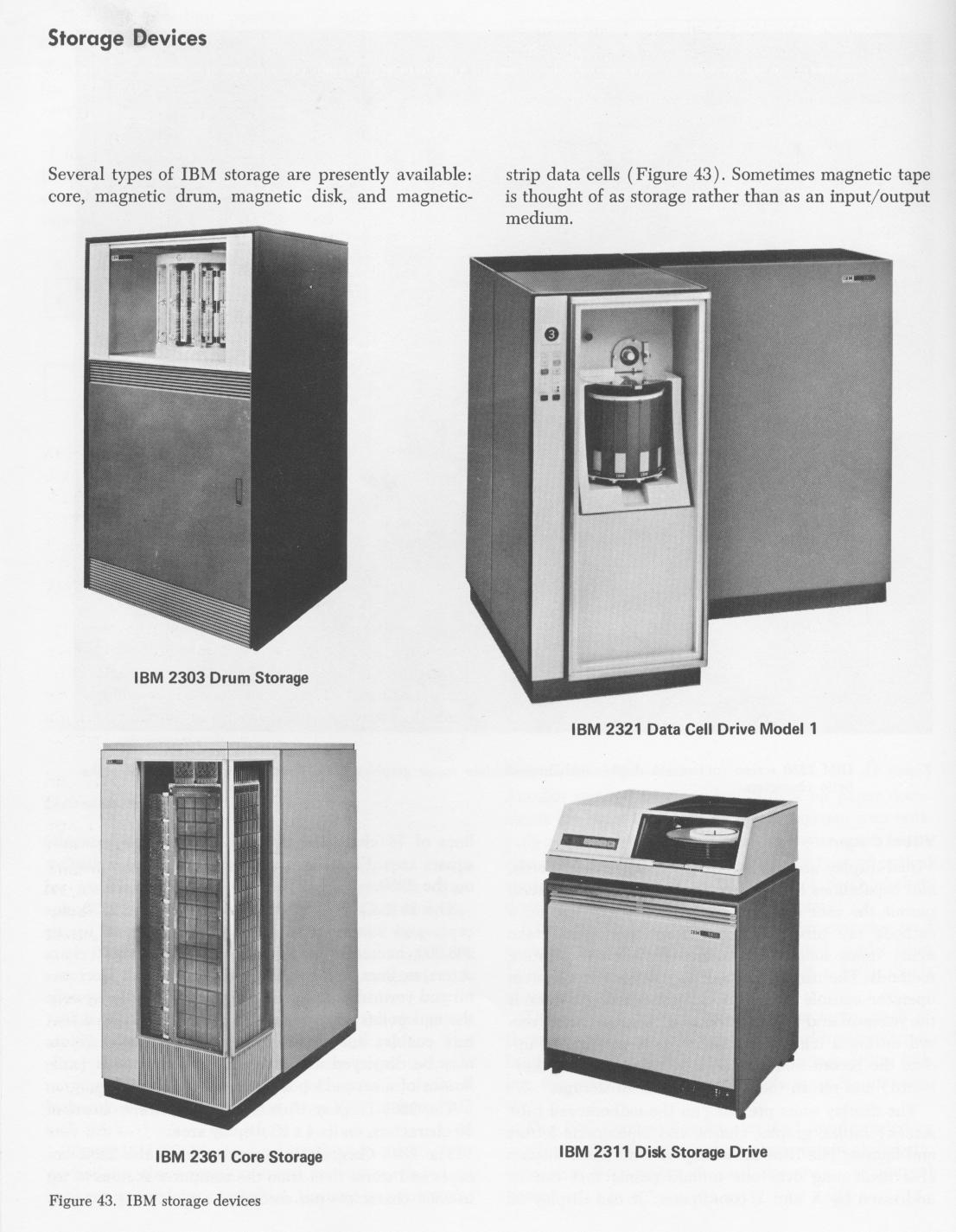
some technology, sort of combination from 2321 datacell and old time disks with single arm moving between platters. it had several hundred floppies all rotating on a single (horizontal) shaft. r/w head moved back&forth along the spindle ... and when the r/w head got into position at the correct floppy ... shot of compressed air (2321 sort of had something similar as part of inserting strip back into its bin) would separate the floppies so the head could be inserted (had sort of leading thin blade that entered first). there was a problem (i don't believe was ever resolved) with the floppy material streching because of the constant spinning (this effort was in the mid-to-late 70s ... after floppies had been invented in san jose ... but before seeing use in PCs).
misc. past post mentioning this large number of floppies on single
spinning spindle
https://www.garlic.com/~lynn/2001.html#48 Competitors to SABRE?
old posts mentioning 2321
https://www.garlic.com/~lynn/2000b.html#41 How to learn assembler language for OS/390 ?
https://www.garlic.com/~lynn/2001.html#51 Competitors to SABRE?
https://www.garlic.com/~lynn/2001f.html#78 HMC . . . does anyone out there like it ?
https://www.garlic.com/~lynn/2001l.html#63 MVS History (all parts)
https://www.garlic.com/~lynn/2002.html#16 index searching
https://www.garlic.com/~lynn/2002.html#22 index searching
https://www.garlic.com/~lynn/2002g.html#84 Questions on IBM Model 1630
https://www.garlic.com/~lynn/2002i.html#26 : Re: AS/400 and MVS - clarification please
https://www.garlic.com/~lynn/2002m.html#40 Wanted: the SOUNDS of classic computing
https://www.garlic.com/~lynn/2002o.html#3 PLX
https://www.garlic.com/~lynn/2003b.html#7 Disk drives as commodities. Was Re: Yamhill
https://www.garlic.com/~lynn/2003b.html#9 Disk drives as commodities. Was Re: Yamhill
https://www.garlic.com/~lynn/2003k.html#36 What is timesharing, anyway?
https://www.garlic.com/~lynn/2003n.html#39 DASD history
https://www.garlic.com/~lynn/2003p.html#22 1960s images of IBM 360 mainframes
https://www.garlic.com/~lynn/2004.html#5 The BASIC Variations
https://www.garlic.com/~lynn/2004.html#6 The BASIC Variations
https://www.garlic.com/~lynn/2004e.html#41 Infiniband - practicalities for small clusters
https://www.garlic.com/~lynn/2004l.html#18 FW: Looking for Disk Calc program/Exec
https://www.garlic.com/~lynn/2004p.html#0 Relational vs network vs hierarchic databases
https://www.garlic.com/~lynn/2005c.html#23 Volume Largest Free Space Problem... ???
https://www.garlic.com/~lynn/2005h.html#32 Software for IBM 360/30
https://www.garlic.com/~lynn/2005t.html#50 non ECC
https://www.garlic.com/~lynn/2005v.html#6 DMV systems?
https://www.garlic.com/~lynn/2006c.html#46 Hercules 3.04 announcement
https://www.garlic.com/~lynn/2006n.html#29 CRAM, DataCell, and 3850
https://www.garlic.com/~lynn/2006n.html#30 CRAM, DataCell, and 3850
https://www.garlic.com/~lynn/2006n.html#31 CRAM, DataCell, and 3850
https://www.garlic.com/~lynn/2006r.html#31 50th Anniversary of invention of disk drives
https://www.garlic.com/~lynn/2006s.html#32 Why magnetic drums was/are worse than disks ?
https://www.garlic.com/~lynn/2006v.html#31 MB to Cyl Conversion
https://www.garlic.com/~lynn/2006y.html#35 The Future of CPUs: What's After Multi-Core?
https://www.garlic.com/~lynn/2007b.html#19 How many 36-bit Unix ports in the old days?
https://www.garlic.com/~lynn/2007e.html#38 FBA rant
https://www.garlic.com/~lynn/2007e.html#51 FBA rant
https://www.garlic.com/~lynn/2007e.html#64 FBA rant
https://www.garlic.com/~lynn/2007f.html#64 John W. Backus, 82, Fortran developer, dies
https://www.garlic.com/~lynn/2007g.html#74 The Perfect Computer - 36 bits?
https://www.garlic.com/~lynn/2007l.html#49 Drums: Memory or Peripheral?
From: Anne & Lynn Wheeler <lynn@garlic.com>
Subject: Re: Does socket represent an interface between ... ?
Newsgroups: comp.protocols.tcp-ip
Date: Wed, 13 Jun 2007 14:56:26 -0600
"Albert Manfredi" <albert.e.manfredi@nospam.com> writes:
part of arpanet and OSI evolving thru the 60s and 70s was support of a homogeneous network (i.e. network of networking nodes). so some number of the IETF RFCs reflect the homogeneous arpanet/OSI type of approach. However, within the IETF community in the 70s ... it was realized that networking wasn't going to be sufficient and work started on internetworking. about the time that ISO finally passed the initial OSI standards in the early 80s ... IETF was converting from homogeneous kind of arpanet networking to internetworking (the big 1jan83 conversion to tcp/ip)
then thruout the 80s, OSI continued to hang on ... somewhat as the difference between networking and internetworking started to slowly permeate the conscience of wider community (even tho still in the 1990 time-frame there were still various gov. mandates to eliminate the internet and have it replaced with ISO/OSI).
possibly, part of the issue of looking at TCP/IP compared to OSI at a purely protocol level ... is that the complexities of internetworking are as much at the operational and business levels ... as the technical/protocol level (although the finer nuances of internetworking technical/protocol have to be in place to enable the operational and business caracteristics).
misc. past posts mentioning OSI and/or attempt at high-speed protocol
standardization effort in ISO ... which was precluded based on violating
OSI model (aka support for both LAN/MAC as well as tcp/ip
internetworking).
https://www.garlic.com/~lynn/subnetwork.html#xtphsp
a few recent posts discussing 1) tcp/ip being the technology basis for
modern internet(working), 2) NSFNET backbone being the initial
operational basis for modern internet(working) and 3) early CIX
(commercial interchange) being the business basis for modern
internet(working)
https://www.garlic.com/~lynn/2007d.html#43 Is computer history taugh now?
https://www.garlic.com/~lynn/2007h.html#38 sizeof() was: The Perfect Computer - 36 bits?
https://www.garlic.com/~lynn/2007i.html#69 How the Internet took over
https://www.garlic.com/~lynn/2007j.html#70 Using rexx to send an email
https://www.garlic.com/~lynn/2007l.html#37 Friday musings on the future of 3270 applications
https://www.garlic.com/~lynn/2007l.html#67 nouns and adjectives
https://www.garlic.com/~lynn/2007l.html#68 nouns and adjectives
https://www.garlic.com/~lynn/2007l.html#69 nouns and adjectives
https://www.garlic.com/~lynn/2007m.html#1 nouns and adjectives
https://www.garlic.com/~lynn/2007m.html#7 nouns and adjectives
From: Anne & Lynn Wheeler <lynn@garlic.com>
Subject: Re: Does socket represent an interface between ... ?
Newsgroups: comp.protocols.tcp-ip
Date: Wed, 13 Jun 2007 17:57:37 -0600
"Albert Manfredi" <albert.e.manfredi@nospam.com> writes:
Old email from long ago and far away. x3s3.3 was ANSI chartered ISO
standards group responsible for "OSI" level 3&4 standards work.
Date: 27 Mar 89 21:41:07
From: wheeler
Quicky note on ansi x3s3.3 and hsp meetings last week. More
information coming as time allows.
A "high speed networking & transport protocol" proposal was
submitted at the x3s3.3 meeting. After various discussions it was
decided to submit a "study proposal for high speed protocols" to the
x3 committee ... the work product of which will be some number of
protocol proposals.
Problems with the original protocol proposal were numerous. Many
people objected to it violating the OSI reference model (and in fact
it is not possible to submit a protocol proposal to X3 that violates
the reference model ... although it is possible to approve an ANSI
standard that does violate the reference model ... but that takes some
fine work ... case in point are the LAN protocols ... especially with
LAN/MAC coming up thru level 1 and 2 well into level 3).
... snip ... top of post, old email index
i.e. it has been possible for ANSI (and/or IEEE) to pass a standard (like the 802 stuff) that violate OSI (just that they couldn't do work on such standardization violating OSI within ISO chartered group... it wasn't possible to have a standard work item accepted for standards work; interesting distinction). x3s3.3 had to object to the hsp work item on grounds that it violated OSI ... 1) supporting internetwork protocol, 2) going directly from transport to LAN/MAC, bypassing level 3/4 interface, and 3) supporting LAN/MAC interface.
other posts on the subject:
https://www.garlic.com/~lynn/subnetwork.html#xtphsp
and for past light hearted post (by somebody else) in this n.g. also
long ago and far away ... but should also be in one of the online
archives
Newsgroups: comp.protocols.tcp-ip,comp.protocols.iso
Date: 1 Apr 88 00:00:01 GMT
Posted: Fri Apr 1 00:00:01 1988
WASHINGTON -- In a simultaneous announcement that took the
computer industry by surprise, OSI leaders today said that they were
abandoning their effort to promote the OSI Protocol Suite in favor of
the existing US Department of Defense (DoD) ARPANET Protocol Suite.
The official reason cited for the decison was a new report from
the Office of Technology Assessment stating that the manpower required
to fully implement and test even the few OSI protocols that are now
defined would consume the entire output of American university
computer science programs for the rest of the century, and that
printing and distributing the necessary protocol specifications would
consume the entire American and Canadian paper supplies for the next
five years.
However, one high-placed source speaking on condition of anonymity
said, ''The whole OSI thing was a practical joke one of the guys
cooked up a few years ago. Nobody ever expected anybody to take it
seriously. I mean, who would believe an organization supposedly
dedicated to tearing down barriers to free and open communications
between computers when it's run by a former director of the National
Security Agency? I guess computer people are a lot more gullible than
we thought. We kept dropping hints, making the whole thing more and
more ridiculous. We hoped that people would eventually catch on, but
it didn't work. Finally, our consciences got to us.''
In related news, officials at the Mitre Corporation in Bedford,
Massachussetts reported that one of their employees, as yet publicly
unidentified, froze ''as solid as stone'' when he heard the
announcement. Medical experts have as yet been unable to communicate
with the victim or get him to relax his facial muscles, which are
reportedly locked into what was described as an ''enormous grin''.
... snip ...
From: Anne & Lynn Wheeler <lynn@garlic.com>
Subject: Re: Is Parallel Programming Just Too Hard?
Newsgroups: bit.listserv.ibm-main,alt.folklore.computers
Date: Wed, 13 Jun 2007 18:45:12 -0600
scott@slp53.sl.home (Scott Lurndal) writes:
here is post from last yr referencing a (mainframe) redbook (category
of technical oriented publications) on effective "scale-up" for some
typical workload enivronments as number of processors go from 1 to 64.
https://www.garlic.com/~lynn/2006l.html#41 One or two CPUs - the pros & cons
other posts in the same thread:
https://www.garlic.com/~lynn/2006l.html#30 One or two CPUs - the pros & cons
https://www.garlic.com/~lynn/2006l.html#43 One or two CPUs - the pros & cons
https://www.garlic.com/~lynn/2006l.html#47 One or two CPUs - the pros & cons
other posts in this thread:
https://www.garlic.com/~lynn/2007l.html#24 Is Parallel Programming Just Too Hard?
https://www.garlic.com/~lynn/2007l.html#26 Is Parallel Programming Just Too Hard?
https://www.garlic.com/~lynn/2007l.html#34 Is Parallel Programming Just Too Hard?
https://www.garlic.com/~lynn/2007l.html#38 Is Parallel Programming Just Too Hard?
https://www.garlic.com/~lynn/2007l.html#60 Is Parallel Programming Just Too Hard?
https://www.garlic.com/~lynn/2007l.html#63 Is Parallel Programming Just Too Hard?
https://www.garlic.com/~lynn/2007m.html#5 Is Parallel Programming Just Too Hard?
https://www.garlic.com/~lynn/2007m.html#13 Is Parallel Programming Just Too Hard?
https://www.garlic.com/~lynn/2007m.html#14 Is Parallel Programming Just Too Hard?
https://www.garlic.com/~lynn/2007m.html#19 Is Parallel Programming Just Too Hard?
https://www.garlic.com/~lynn/2007m.html#22 Is Parallel Programming Just Too Hard?
From: Anne & Lynn Wheeler <lynn@garlic.com>
Subject: Re: nouns and adjectives
Newsgroups: alt.folklore.computers
Date: Wed, 13 Jun 2007 20:09:02 -0600
scott@slp53.sl.home (Scott Lurndal) writes:
i.e. i was recently contacted by some of the identity players about
beefing up our merged security taxonomy & glossary with a lot more
related to identity.
https://www.garlic.com/~lynn/index.html#glosnote
so when we were called in to consult with this small client/server
startup that wanted to do payment transactions ... they had this
technology called SSL ... but it was server to client authentication.
For the thing called "payment gateway"
https://www.garlic.com/~lynn/subnetwork.html#gateway
... that actually handled the transactions between the commerce server and the financial infrastructure payment infrastructure ... we had mandated "mutual" authentication (something that hadn't been implemented at the time). this required both parties to present digital certificates.
it was in this exercise that we realized that the digital certificates
were actually obsolete, redundant and superfluous ... because both
parties already had recorded information about the other party ...
including the other party's public key. the resulting use of the
(redundant and superfluous) digital certificates was purely an
artifact of leveraging the already existing SSL software libraries
... which had implicit, builtin need for digital certificates. misc.
past posts about SSL and SSL digital certificates:
https://www.garlic.com/~lynn/subpubkey.html#sslcerts
later we did some work in the x9a10 financial standard working group
which had been given the requirement in the mid-90s to preserve the
integrity of the financial infrastructure for all retail payments.
the result was the x9.59 financial standard
https://www.garlic.com/~lynn/x959.html#x959
we had realized from the earlier work on payment transaction support
with the small client/server startup that had this SSL technology ...
that the relying party had all the necessary information and records
about the clients ... and therefor digital certificates were redundant
and superfluous ... and so promoted a certificate-less public key
authentication infrastructure
https://www.garlic.com/~lynn/subpubkey.html#certless
something similar was done for the Kerberos pk-init draft standard ...
just specify that a public key is recorded in lieu of a password ...
which is sufficient to perform (certificate-less) digital
signature authentication. It was later that heavy lobbying was done to
have the pk-init draft include a certificate mode of operation
(although one of the prime instigators responsible has subsequently
contacted us and apologized for how wrong he was).
https://www.garlic.com/~lynn/subpubkey.html#kerberos
something similar has been done for (certificate-less, public
key) RADIUS (the other major internet authentication protocol in use
across the world today)
https://www.garlic.com/~lynn/subpubkey.html#radius
part of the x9.59 standardization process ... also recognized that the
payment transaction has in use by dozens of processes spanning
numerous different business entities ... a purely "session" oriented
protocol protecting transmission of data across the internet wasn't
going to be sufficient ... since the transaction was exposed as a
large number of different points. So the other aspect of x9.59
fianncial standard transaction, was the actual transaction was
"armored" on an end-to-end basis (from origin all thru way thru the
multitude of different business processes and entities that might
touch the transaction). This eliminated the possible vulnerabilities
that occur in purely session oriented operation. Lots of discussion
about the difference in threats, exploits, and vulnerabilities between
a session oriented paradigm and an armored transaction paradigm
https://www.garlic.com/~lynn/subintegrity.html#payments
the other part of the x9.59 financial standards work was the
observation that a certificate-based transaction implementation added
enormous payload and processing bloat to an existing payment
transaction ... increasing the payload size and the processing
overhead (for just the certificate part) by a factor of 100 times
https://www.garlic.com/~lynn/subpubkey.html#bloat
as part of the x9.59 work in the 90s ... there was also work on the
AADS chip strawman. Some other hardware token oriented work going on
in the period were making claims that truely secure hardware tokens
were too expensive ... and so they had to compromise with other kinds
of chips. This led to implementations like the YES CARD
https://www.garlic.com/~lynn/subintegrity.html#yescard
we somewhat facetiously claimed that we were going to take a $500
mil-spec part and aggressively cost-reduce it by 2-3 orders of
magnitude ... so the incremental cost of adding such a chip to an
existing magstripe card distribution was significantly less than the
fully loaded cost of personalizing and distributing magstripe cards.
https://www.garlic.com/~lynn/x959.html#aads
the key pair for the chip was generated in the fab as part of the standard power-on/testing done before the wafer was even sliced & diced. The result was that the institution that shipped the card registered the (card/chip) public key in the standard account record ... along with the other administrative information done as part of card personalization and ship (i.e. date the mailer went out and other gorp that goes on as part of the standard card distribution infrastructure).
As a result, there was the possibility of an extremely high integrity, fully functional public key authentication infrastructure at very close to zero incremental cost ... and the whole enormous complexity and cost of a PKI, digital certificate oriented operation is totally avoided.
One of the other issues that was done as part of x9.59 and AADS was looking at the issues from transitioning from an institution-centric hardware token infrastructure ... to a person-centric hardware token infrastructure ... i.e. that the same identical AADS hardware token would support public key oriented authentication for x9.59, radius, kerberos and a large variety other possible infrastructures ... w/o any special considerations and/or requirement to load different software and/or provide additional initialization for the token.
misc. recent postings mentioning the work on person-centric
paradigm considerations:
https://www.garlic.com/~lynn/2007b.html#12 Special characters in passwords was Re: RACF - Password rules
https://www.garlic.com/~lynn/2007b.html#13 special characters in passwords
https://www.garlic.com/~lynn/2007d.html#12 One Time Identification, a request for comments/testing
https://www.garlic.com/~lynn/2007l.html#8 John W. Backus, 82, Fortran developer, dies
https://www.garlic.com/~lynn/2007l.html#9 John W. Backus, 82, Fortran developer, dies
https://www.garlic.com/~lynn/2007l.html#43 My Dream PC -- Chip-Based
for additional topic drift, even with a public key hardware token at
the highest integrity level ... there are other kinds of
vulnerabilities and exploits that might occur in the environment where
a digital signature originates. The EU has done the FINREAD (financial
reader) standard for home/personal use that has countermeasures
for some of these other kinds of vulnerabilities and countermeasures.
Lots of past posts related to FINREAD standard and possible
vulnerabilities and exploits
https://www.garlic.com/~lynn/subintegrity.html#finread
From: Anne & Lynn Wheeler <lynn@garlic.com>
Subject: OSI abandoned!
Newsgroups: comp.protocols.tcp-ip
Date: Wed, 13 Jun 2007 20:24:22 -0600
Albert Manfredi <bert22306@hotmail.com> writes:
i pulled the copy out of my email archive ... ... as i mentioned in the
previous post, should be able to find it in one of the online usenet
archives. here is version ... posted Mar 31 1988, 7:00 pm
http://groups.google.com/group/comp.protocols.tcp-ip/browse_thread/thread/42eb18a6c94f6541/123b59f7f112234b?lnk=st&q=&rnum=3#123b59f7f112234b
so are you referring to a warmed over version of the above nearly a decade later? ... or when some specific party/organization ... taking nearly another decade to actually accept it.
for other topic drift ... various old email mentioning NSFNET backbone
activity thru the 80s
https://www.garlic.com/~lynn/lhwemail.html#nsfnet
From: Anne & Lynn Wheeler <lynn@garlic.com>
Subject: Re: Is Parallel Programming Just Too Hard?
Newsgroups: bit.listserv.ibm-main,alt.folklore.computers
Date: Thu, 14 Jun 2007 09:09:18 -0600
Intel readies massive multicore processors
from above:
Researchers at Intel are working on ways to mask the intricate
functionality of massive multicore chips to make it easier for computer
makers and software developers to adapt to them, said Jerry Bautista,
co-director of Intel's Tera-scale Computing Research Program.
... snip ...
From: Anne & Lynn Wheeler <lynn@garlic.com>
Subject: Re: Bulkiest removable storage media?
Newsgroups: alt.folklore.computers,comp.arch.storage
Date: Thu, 14 Jun 2007 09:14:20 -0600
Quadibloc <jsavard@ecn.ab.ca> writes:
well before the start of steep decline in hard disk prices (and well before cdroms)
'80 Mbytes of storage for under $12k!' and other ad favorites through the years
http://www.computerworld.com/action/article.do?command=viewArticleBasic&articleId=9023960
From: Anne & Lynn Wheeler <lynn@garlic.com>
Subject: Re: nouns and adjectives
Newsgroups: alt.folklore.computers
Date: Thu, 14 Jun 2007 10:15:18 -0600
Anne & Lynn Wheeler <lynn@garlic.com> writes:
part of the aggressive cost reduction was eliminating chip features (that didn't affect performance or integrity) as means of reducing chip area. manufacturing costs are basically per wafer (so as the number of chips per wafer goes up, the per chip cost comes down) and post manufacturing per chip processing (with person-centric operation and key generation export as part of existing power-on test, large number of post/per-chip manufacturing steps are eliminated).
one of the limiting factors here with super small chips (like aads chip strawman or some of the RFID chips) is when they become smaller than the size of the saw cut (used to slice and dice the wafers) ... loosing most of the wafer area to the saw. so there has been work on developing other techniques for slicing and dicing wafers.
recent news item:
Dicing tool
http://www.theengineer.co.uk/Articles/300270/Dicing+tool.htm
and somewhat related paper
Laser dicing of chip scale and silicon wafer scale packages
http://ieeexplore.ieee.org/Xplore/login.jsp?url=/iel5/8681/27505/01225869.pdf
other recent references:
https://www.garlic.com/~lynn/aadsm24.htm#49 Crypto to defend chip IP: snake oil or good idea?
https://www.garlic.com/~lynn/aadsm25.htm#1 Crypto to defend chip IP: snake oil or good idea?
https://www.garlic.com/~lynn/2007l.html#12 My Dream PC -- Chip-Based
https://www.garlic.com/~lynn/2007l.html#13 My Dream PC -- Chip-Based
From: Anne & Lynn Wheeler <lynn@garlic.com>
Subject: Re: Patents, Copyrights, Profits, Flex and Hercules
Newsgroups: bit.listserv.ibm-main,alt.folklore.computers
Date: Thu, 14 Jun 2007 13:23:31 -0600
bblack@ibm-main.lst (Bruce Black) writes:
i had done the original backup/archive implementation in the late 70s which was deployed at some number of internal datacenters ... and went thru a number of versions with various other people helping with the work.
one of the people involved left ... and worked on a number of backup/archive implementations for other companies ... some of these other implementations may currently be sold by sterling(?).
my original backup/archive internal implementation first saw product
release as workstation datasave facility which then morphed into ADSM
(before being renamed TSM). some old email on the subject
https://www.garlic.com/~lynn/lhwemail.html#cmsback
and numerous posts mentioning backup/archive
https://www.garlic.com/~lynn/submain.html#backup
From: Anne & Lynn Wheeler <lynn@garlic.com>
Subject: Re: nouns and adjectives
Newsgroups: alt.folklore.computers
Date: Thu, 14 Jun 2007 18:27:27 -0600
Online Bank Security Worsens
from above:
This year's Annual Security Report from NTA Monitor, a security testing
firm, found that 20 percent more security vulnerabilities turned up in
the infrastructures of banks,
... snip ...
misc. past posts in this thread (some totally unrelated):
https://www.garlic.com/~lynn/2007l.html#67 nouns and adjectives
https://www.garlic.com/~lynn/2007l.html#68 nouns and adjectives
https://www.garlic.com/~lynn/2007l.html#69 nouns and adjectives
https://www.garlic.com/~lynn/2007l.html#70 nouns and adjectives
https://www.garlic.com/~lynn/2007m.html#1 nouns and adjectives
https://www.garlic.com/~lynn/2007m.html#3 nouns and adjectives
https://www.garlic.com/~lynn/2007m.html#7 nouns and adjectives
https://www.garlic.com/~lynn/2007m.html#27 nouns and adjectives
https://www.garlic.com/~lynn/2007m.html#31 nouns and adjectives
From: Anne & Lynn Wheeler <lynn@garlic.com>
Subject: Re: IBM 8000 ???
Newsgroups: alt.folklore.computers
Date: Fri, 15 Jun 2007 08:55:39 -0600
hancock4 writes:
misc. past posts referencing the testimony at anti-trust trial
https://www.garlic.com/~lynn/94.html#44 bloat
https://www.garlic.com/~lynn/99.html#231 Why couldn't others compete against IBM?
https://www.garlic.com/~lynn/2001j.html#33 Big black helicopters
https://www.garlic.com/~lynn/2003.html#71 Card Columns
https://www.garlic.com/~lynn/2005k.html#0 IBM/Watson autobiography--thoughts on?
this theme is also related to Amdahl's comment in his talk at MIT (in
the early 70s) when asked what justification did he use with the VC
money people started his business ... aka that companies had already
invested something like $200B in application software ... and even if
IBM were to totally walk away from 360/370 ... possibly a veiled
reference to future system project
https://www.garlic.com/~lynn/submain.html#futuresys
... that installed software base would keep him in business thru the end of the century.
the other view would be that businesses were more likely to sink that sort of investment into software development ... if they thot the investment had long term benefit to the company i.e. would be re-usable over many generations of the same machine line as well as different machine lines, as the business's computing requirements exploded (protecting the customer's "investment" has been a frequent re-occurring theme). In later generations, there were other avenues attempting to address the software investment ... things like portable software technologies as well as attempting to significantly reduce software costs (including COTS, commericial off the shelf ... instead of RYO, roll-your-own).
past posts referencing Amdahl's talk at MIT:
https://www.garlic.com/~lynn/2001j.html#23 OT - Internet Explorer V6.0
https://www.garlic.com/~lynn/2002j.html#20 MVS on Power (was Re: McKinley Cometh...)
https://www.garlic.com/~lynn/2003.html#36 mainframe
https://www.garlic.com/~lynn/2003e.html#13 unix
https://www.garlic.com/~lynn/2003e.html#15 unix
https://www.garlic.com/~lynn/2003h.html#32 IBM system 370
https://www.garlic.com/~lynn/2003i.html#3 A Dark Day
https://www.garlic.com/~lynn/2003p.html#30 Not A Survey Question
https://www.garlic.com/~lynn/2004d.html#22 System/360 40th Anniversary
https://www.garlic.com/~lynn/2004h.html#20 Vintage computers are better than modern crap !
https://www.garlic.com/~lynn/2004l.html#51 Specifying all biz rules in relational data
https://www.garlic.com/~lynn/2004m.html#53 4GHz is the glass ceiling?
https://www.garlic.com/~lynn/2004o.html#66 Integer types for 128-bit addressing
https://www.garlic.com/~lynn/2005b.html#47 The mid-seventies SHARE survey
https://www.garlic.com/~lynn/2005e.html#35 Thou shalt have no other gods before the ANSI C standard
https://www.garlic.com/~lynn/2005r.html#49 MVCIN instruction
https://www.garlic.com/~lynn/2006.html#7 EREP , sense ... manual
https://www.garlic.com/~lynn/2006c.html#18 Change in computers as a hobbiest
https://www.garlic.com/~lynn/2007f.html#61 Is computer history taught now?
https://www.garlic.com/~lynn/2007f.html#77 John W. Backus, 82, Fortran developer, dies
https://www.garlic.com/~lynn/2007g.html#57 IBM to the PCM market(the sky is falling!!!the sky is falling!!)
https://www.garlic.com/~lynn/2007k.html#46 John W. Backus, 82, Fortran developer, dies
https://www.garlic.com/~lynn/2007m.html#15 Patents, Copyrights, Profits, Flex and Hercules
From: Anne & Lynn Wheeler <lynn@garlic.com>
Subject: Boyd, Metcalfe, and Amdahl all in one article
Newsgroups: alt.folklore.computers
Date: Fri, 15 Jun 2007 09:56:58 -0600
Boyd, Metcalfe, and Amdahl - Modelling Networked Warfighting Systems:
from above:
Conclusions
• Amdahl's Law provides a valuable abstraction for modelling the impact
of the Decision-Action phases of the OODA-loop on system capability
gains.
• Amdahl's Law complements Metcalfe's Law by providing for a complete
abstraction to model OODA-loop behaviour.
• Amdahl's Law presents a model which relates achievable numbers of
engagements to time.
• Metcalfe's Law, conversely, presents capability gains indirectly, as
it measures utility in terms of connectivity.
• Fusion of Boyd, Metcalfe and Amdahl provides an intellectual framework
for understanding capability gains in networked warfighting systems.
... snip ...
lots of past posts mentioning Boyd
https://www.garlic.com/~lynn/subboyd.html#boyd
and various URLs from around the web mentioning Boyd
and/or OODA-loops
https://www.garlic.com/~lynn/subboyd.html#boyd2
From: Anne & Lynn Wheeler <lynn@garlic.com>
Subject: Re: Future of System/360 architecture?
Newsgroups: alt.folklore.computers
Date: Fri, 15 Jun 2007 13:21:11 -0600
hancock4 writes:
for instance, we had a one week "JAD" with taligent in the mid-90s
that came to the conclusion that about 1/3rd (very specific) new code
was needed and something like 1/3rd of the existing code had to be
rewritten ... just to address the business critical requirements
... that doesn't get to the scale-up issues. misc. past posts:
https://www.garlic.com/~lynn/2000e.html#46 Where are they now : Taligent and Pink
https://www.garlic.com/~lynn/2001n.html#93 Buffer overflow
https://www.garlic.com/~lynn/2004p.html#64 Systems software versus applications software definitions
https://www.garlic.com/~lynn/2005b.html#40 [Lit.] Buffer overruns
https://www.garlic.com/~lynn/2005f.html#38 Where should the type information be: in tags and descriptors
https://www.garlic.com/~lynn/2005i.html#42 Development as Configuration
two buzz words from these projects in the 90s, were overnight batch window and straight-through processing.
some of the monstrous software development disasters of the 90s were around major transaction operations (payments, trading, settlement, etc). these are operations that had "online" front-ends built during the 70s & 80s ... but final processing actually finished up in the overnight batch windows. as business grew ... the batch window was stressed ... and globalization further increased the workload stress on the batch window ... and also cut the amount of time for the window (since it wasn't necessarily "overnight" all around the world).
the "new" technology in the 90s was to re-engineer the infrastructure and do "real-time", straight-through processing ... i.e. each transaction went straight-through to final completion ... instead of final completion being queued for the overnight batch window (attempting to totally eliminate the overnight batch window)
the issue was that the new technology and "real-time" processing was
less efficient than batch ... so, in theory, this would be made up
with lots of parallelized COTS processing. the problem was that much
of this new generation of software engineers didn't appear to know how
to do back-of-the-envelope speeds&feeds calculations. This is
something that was somewhat specialized at the science center
https://www.garlic.com/~lynn/subtopic.html#545tech
in the 60s & 70s ... performance tuning, workload profiling, and
laying the whole ground work for stuff like capacity planning
https://www.garlic.com/~lynn/submain.html#benchmark
so it frequently turned out that these great, new effort's "less efficiency" was on the order of two orders of magnitude (100 times). this is where quantitative really becomes qualitative ... and the project eventually goes down in flames possibly after several tens, hundreds, or thousands of million.
we were even called into the middle of one of these massive projects (before the realization that it couldn't succeed had started to permeate the organization) ... and the first thing we did was the back-of-the-envelope speeds&feeds calculations.
there was a recent article mentioning that nothing succeeds like failure ...
it is possible that some of the large system integrators
acquired a substantial appetite for failing projects in this period
... since if they were to succeed, then there wouldn't be the next
(big, expensive) follow-on effort.
https://www.garlic.com/~lynn/aadsm26.htm#59 On cleaning up the security mess: escaping the self-perpetuating trap of Fraud?
https://www.garlic.com/~lynn/aadsm27.htm#8 Leadership, the very definition of fraud, and the court of security ideas
https://www.garlic.com/~lynn/2007e.html#29 Securing financial transactions a high priority for 2007
https://www.garlic.com/~lynn/2007e.html#62 Securing financial transactions a high priority for 2007
https://www.garlic.com/~lynn/2007h.html#29 sizeof() was: The Perfect Computer - 36 bits?
https://www.garlic.com/~lynn/2007h.html#48 Securing financial transactions a high priority for 2007
https://www.garlic.com/~lynn/2007h.html#55 ANN: Microsoft goes Open Source
https://www.garlic.com/~lynn/2007l.html#46 My Dream PC -- Chip-Based
a lot of what is happening now ... isn't so much the re-engineering of the core (backroom, batch) applications ... but "webizing" the online parts.
say a customer call center (trouble center, catalogue order, etc) ... that has a lot of screens/menus to walk the person answering the phone thru what ever the customer has called about. Lay in a bunch of authentication, identification, authorization, etc in the middle ... and let the end-user directly walk thru the call-center screens (via web/browser) ... eliminating a lot of the 1-800 calls (aka "self-service").
we had done a lot of work in ha/cmp
https://www.garlic.com/~lynn/subtopic.html#hacmp
for both commercial and numerical intensive scale-up
https://www.garlic.com/~lynn/lhwemail.html#medusa
with both loosely-coupled (cluster) and tightly-coupled scale-up. Much of that got side-tracked into numerical intensive for national labs and high-energy physics.
some of that is starting to come back into the commercial sector ...
but (at least initially) very much as new, numerical intensive
applications ... like (securities) trading house using massive GRID
doing near real-time trading decisions ... recent post:
https://www.garlic.com/~lynn/2007l.html#34 Is Parallel Programming Just Too Hard?
we still periodically run into references where large commercial operations still have extensive IMS database operation ... with potentially the amount of data in IMS databases is still larger than the amount of data in RDBMS (which represents significant market inhibitor to backend/backroom conversions).
lots of past posts mentioning IMS:
https://www.garlic.com/~lynn/98.html#35a Drive letters
https://www.garlic.com/~lynn/98.html#37 What is MVS/ESA?
https://www.garlic.com/~lynn/98.html#40 Comparison Cluster vs SMP?
https://www.garlic.com/~lynn/99.html#58 When did IBM go object only
https://www.garlic.com/~lynn/99.html#71 High Availabilty on S/390
https://www.garlic.com/~lynn/99.html#77 Are mainframes relevant ??
https://www.garlic.com/~lynn/99.html#92 MVS vs HASP vs JES (was 2821)
https://www.garlic.com/~lynn/99.html#128 Examples of non-relational databases
https://www.garlic.com/~lynn/2000.html#13 Computer of the century
https://www.garlic.com/~lynn/2000c.html#45 Does the word "mainframe" still have a meaning?
https://www.garlic.com/~lynn/2000c.html#47 Does the word "mainframe" still have a meaning?
https://www.garlic.com/~lynn/2000f.html#12 Amdahl Exits Mainframe Market
https://www.garlic.com/~lynn/2000f.html#30 OT?
https://www.garlic.com/~lynn/2000f.html#54 360 Architecture, Multics, ... was (Re: X86 ultimate CISC? No.)
https://www.garlic.com/~lynn/2001.html#22 Disk caching and file systems. Disk history...people forget
https://www.garlic.com/~lynn/2001c.html#31 database (or b-tree) page sizes
https://www.garlic.com/~lynn/2001c.html#69 Wheeler and Wheeler
https://www.garlic.com/~lynn/2001d.html#71 Pentium 4 Prefetch engine?
https://www.garlic.com/~lynn/2001e.html#2 Block oriented I/O over IP
https://www.garlic.com/~lynn/2001g.html#44 The Alpha/IA64 Hybrid
https://www.garlic.com/~lynn/2001g.html#46 The Alpha/IA64 Hybrid
https://www.garlic.com/~lynn/2001i.html#41 Withdrawal Announcement 901-218 - No More 'small machines'
https://www.garlic.com/~lynn/2001j.html#23 OT - Internet Explorer V6.0
https://www.garlic.com/~lynn/2001k.html#13 HP-UX will not be ported to Alpha (no surprise)exit
https://www.garlic.com/~lynn/2001k.html#14 HP-UX will not be ported to Alpha (no surprise)exit
https://www.garlic.com/~lynn/2001k.html#18 HP-UX will not be ported to Alpha (no surprise)exit
https://www.garlic.com/~lynn/2001l.html#47 five-nines
https://www.garlic.com/~lynn/2001n.html#0 TSS/360
https://www.garlic.com/~lynn/2001n.html#3 News IBM loses supercomputer crown
https://www.garlic.com/~lynn/2001n.html#47 Sysplex Info
https://www.garlic.com/~lynn/2001n.html#85 The demise of compaq
https://www.garlic.com/~lynn/2002.html#1 The demise of compaq
https://www.garlic.com/~lynn/2002.html#10 index searching
https://www.garlic.com/~lynn/2002b.html#54 Computer Naming Conventions
https://www.garlic.com/~lynn/2002e.html#68 Blade architectures
https://www.garlic.com/~lynn/2002f.html#50 Blade architectures
https://www.garlic.com/~lynn/2002g.html#48 Why did OSI fail compared with TCP-IP?
https://www.garlic.com/~lynn/2002h.html#73 Where did text file line ending characters begin?
https://www.garlic.com/~lynn/2002j.html#45 M$ SMP and old time IBM's LCMP
https://www.garlic.com/~lynn/2002o.html#14 Home mainframes
https://www.garlic.com/~lynn/2002o.html#68 META: Newsgroup cliques?
https://www.garlic.com/~lynn/2002p.html#54 Newbie: Two quesions about mainframes
https://www.garlic.com/~lynn/2002q.html#35 HASP:
https://www.garlic.com/~lynn/2003.html#37 Calculating expected reliability for designed system
https://www.garlic.com/~lynn/2003.html#40 InfiniBand Group Sharply, Evenly Divided
https://www.garlic.com/~lynn/2003f.html#15 Alpha performance, why?
https://www.garlic.com/~lynn/2003h.html#56 The figures of merit that make mainframes worth the price
https://www.garlic.com/~lynn/2003k.html#22 What is timesharing, anyway?
https://www.garlic.com/~lynn/2003l.html#11 how long does (or did) it take to boot a timesharing system?
https://www.garlic.com/~lynn/2003n.html#22 foundations of relational theory? - some references for the
https://www.garlic.com/~lynn/2003n.html#29 Architect Mainframe system - books/guidenance
https://www.garlic.com/~lynn/2004.html#40 AMD/Linux vs Intel/Microsoft
https://www.garlic.com/~lynn/2004.html#49 Mainframe not a good architecture for interactive workloads
https://www.garlic.com/~lynn/2004c.html#21 PSW Sampling
https://www.garlic.com/~lynn/2004c.html#31 Moribund TSO/E
https://www.garlic.com/~lynn/2004e.html#22 Pre-relational, post-relational, 1968 CODASYL "Survey of Data Base Systems"
https://www.garlic.com/~lynn/2004g.html#8 network history
https://www.garlic.com/~lynn/2004m.html#16 computer industry scenairo before the invention of the PC?
https://www.garlic.com/~lynn/2004m.html#46 Shipwrecks
https://www.garlic.com/~lynn/2004n.html#16 RISCs too close to hardware?
https://www.garlic.com/~lynn/2004n.html#28 Is Fast Path headed nowhere?
https://www.garlic.com/~lynn/2004o.html#5 Integer types for 128-bit addressing
https://www.garlic.com/~lynn/2004o.html#67 Relational vs network vs hierarchic databases
https://www.garlic.com/~lynn/2004p.html#49 History of C
https://www.garlic.com/~lynn/2004q.html#23 1GB Tables as Classes, or Tables as Types, and all that
https://www.garlic.com/~lynn/2004q.html#75 [Lit.] Buffer overruns
https://www.garlic.com/~lynn/2005.html#46 8086 memory space
https://www.garlic.com/~lynn/2005c.html#7 [Lit.] Buffer overruns
https://www.garlic.com/~lynn/2005c.html#67 intel's Vanderpool and virtualization in general
https://www.garlic.com/~lynn/2005d.html#9 intel's Vanderpool and virtualization in general (was Re: Cell press release, redacted.)
https://www.garlic.com/~lynn/2005e.html#21 He Who Thought He Knew Something About DASD
https://www.garlic.com/~lynn/2005j.html#60 Ancient history
https://www.garlic.com/~lynn/2005m.html#52 Cluster computing drawbacks
https://www.garlic.com/~lynn/2005n.html#25 Data communications over telegraph circuits
https://www.garlic.com/~lynn/2005o.html#30 auto reIPL
https://www.garlic.com/~lynn/2005o.html#37 What ever happened to Tandem and NonStop OS ?
https://www.garlic.com/~lynn/2005p.html#15 DUMP Datasets and SMS
https://www.garlic.com/~lynn/2005p.html#44 hasp, jes, rasp, aspen, gold
https://www.garlic.com/~lynn/2005r.html#10 Intel strikes back with a parallel x86 design
https://www.garlic.com/~lynn/2005r.html#12 Intel strikes back with a parallel x86 design
https://www.garlic.com/~lynn/2005t.html#49 FULIST
https://www.garlic.com/~lynn/2005u.html#23 Channel Distances
https://www.garlic.com/~lynn/2005u.html#37 Mainframe Applications and Records Keeping?
https://www.garlic.com/~lynn/2005v.html#0 DMV systems?
https://www.garlic.com/~lynn/2006.html#32 UMA vs SMP? Clarification of terminology
https://www.garlic.com/~lynn/2006f.html#19 Over my head in a JES exit
https://www.garlic.com/~lynn/2006h.html#52 Need Help defining an AS400 with an IP address to the mainframe
https://www.garlic.com/~lynn/2006i.html#2 The Pankian Metaphor
https://www.garlic.com/~lynn/2006i.html#34 TOD clock discussion
https://www.garlic.com/~lynn/2006m.html#32 Old Hashing Routine
https://www.garlic.com/~lynn/2006n.html#8 Not Your Dad's Mainframe: Little Iron
https://www.garlic.com/~lynn/2006q.html#26 garlic.com
https://www.garlic.com/~lynn/2006r.html#4 Was FORTRAN buggy?
https://www.garlic.com/~lynn/2006s.html#42 Ranking of non-IBM mainframe builders?
https://www.garlic.com/~lynn/2006u.html#30 Why so little parallelism?
https://www.garlic.com/~lynn/2006u.html#55 What's a mainframe?
https://www.garlic.com/~lynn/2006w.html#27 Generalised approach to storing address details
https://www.garlic.com/~lynn/2006x.html#1 IBM sues maker of Intel-based Mainframe clones
https://www.garlic.com/~lynn/2006x.html#8 vmshare
https://www.garlic.com/~lynn/2007.html#1 "The Elements of Programming Style"
https://www.garlic.com/~lynn/2007.html#39 Just another example of mainframe costs
https://www.garlic.com/~lynn/2007b.html#9 Mainframe vs. "Server" (Was Just another example of mainframe
https://www.garlic.com/~lynn/2007b.html#48 6400 impact printer
https://www.garlic.com/~lynn/2007c.html#42 Keep VM 24X7 365 days
https://www.garlic.com/~lynn/2007d.html#24 How many 36-bit Unix ports in the old days?
https://www.garlic.com/~lynn/2007e.html#1 Designing database tables for performance?
https://www.garlic.com/~lynn/2007e.html#14 Cycles per ASM instruction
https://www.garlic.com/~lynn/2007e.html#16 Attractive Alternatives to Mainframes
https://www.garlic.com/~lynn/2007e.html#31 Quote from comp.object
https://www.garlic.com/~lynn/2007e.html#37 Quote from comp.object
https://www.garlic.com/~lynn/2007e.html#41 IBM S/360 series operating systems history
https://www.garlic.com/~lynn/2007f.html#56 Is computer history taught now?
https://www.garlic.com/~lynn/2007f.html#64 John W. Backus, 82, Fortran developer, dies
https://www.garlic.com/~lynn/2007f.html#66 IBM System z9
https://www.garlic.com/~lynn/2007g.html#25 Bidirectional Binary Self-Joins
https://www.garlic.com/~lynn/2007g.html#26 Bidirectional Binary Self-Joins
https://www.garlic.com/~lynn/2007g.html#80 IBM to the PCM market(the sky is falling!!!the sky is falling!!)
https://www.garlic.com/~lynn/2007h.html#35 sizeof() was: The Perfect Computer - 36 bits?
https://www.garlic.com/~lynn/2007h.html#76 John W. Backus, 82, Fortran developer, dies
https://www.garlic.com/~lynn/2007j.html#44 John W. Backus, 82, Fortran developer, dies
https://www.garlic.com/~lynn/2007j.html#71 John W. Backus, 82, Fortran developer, dies
https://www.garlic.com/~lynn/2007k.html#71 The top 10 dead (or dying) computer skills
https://www.garlic.com/~lynn/2007l.html#62 Friday musings on the future of 3270 applications
From: Anne & Lynn Wheeler <lynn@garlic.com>
Subject: Re: Is Parallel Programming Just Too Hard?
Newsgroups: bit.listserv.ibm-main,alt.folklore.computers
Date: Fri, 15 Jun 2007 18:02:30 -0600
Peter Flass <Peter_Flass@Yahoo.com> writes:
From: Anne & Lynn Wheeler <lynn@garlic.com>
Subject: Re: OSI abandoned!
Newsgroups: comp.protocols.tcp-ip
Date: Fri, 15 Jun 2007 18:09:22 -0600
re:
note, something being wrong and/or incomplete doesn't preclude it from being a great education tool ... in fact, compare&contrast can be really useful as part of an educational activity.
and from random quotes department
Introduction to Routing
http://www.corecom.com/html/OSNconnexions.html
from above ...
... Ten years ago, however, a similarly simplistic argument destroyed
the opportunity for OSI to standardize one of the best features of the
TCP/IP internetwork architecture-the combination of a connectionless
(datagram) internetwork protocol (which could be operated efficiently
over any underlying network technology, whether based on datagrams or
virtual circuits) with a connection-oriented end-to-end transport
protocol. The OSI position at that time was that a connection-oriented
service at the transport layer "naturally" mapped to a
connection-oriented service at the network layer, as if this were
something inherent in the very architecture of a layered model. The
OSI community wasted years dealing with this red herring, which was
intended to divert attention from the fact that a large segment of the
OSI community believed that the service provided by the network layer
was an end-to-end transport service. The TCP/IP community,
unencumbered by such nonsense, happily expanded to fill the resulting
vacuum.
... snip ...
as per previous email reference about x3s3.3 nearly needing multiple
personalities to handle ISO ... i.e. (at least during the 80s), x3s3.3
couldn't work on protocols that violated OSI (like possibly involving
internetworking and/or LANs) ... but X3 (and other ISO chartered
standards bodies) could vote to approve such standards (that might
violate OSI i.e. various IEEE 80x standards being case in point)
https://www.garlic.com/~lynn/2007m.html#email890327
and, of course, IETF never had such a short-coming ... and as above randomly selected quote also somewhat implies ... it would be possible to craft an RFC on how to handle some OSI feature within an internetworking environment. the difficulty of some of the ISO stuff within the IETF framework ... for something to progress in the standards process required multiple interoperable implementations (something that wasn't required for something to become an ISO standard).
as to having softcopy of various GOSIP (and various other) documents
misc. past posts with gosip references and/or partial extracts from
some of the documents from the period
https://www.garlic.com/~lynn/2000d.html#70 When the Internet went private
https://www.garlic.com/~lynn/2002i.html#15 Al Gore and the Internet
lots of past posts referencing OSI, X3S3.3 ISO standards work,
and/or efforts behind HSP (high-speed protocol) in X3S3.3
https://www.garlic.com/~lynn/subnetwork.html#xtphsp
and pointers to RFC and IETF topics can be found in my RFC IETF index
https://www.garlic.com/~lynn/rfcietff.htm
for lots of topic drift about IETF coming to grips with another aspect of progressing standards, hot off the press ... aka frequently RFC standard progressing had been held up until the corresponding normative reference(s) had also progressed.
4897 I Handling Normative References to Standards-Track Documents, Hartman S., Klensin J., 2007/06/13 (6pp) (.txt=13023) (BCP-97) (Updates 3967) (Refs 3967) (was draft-klensin-norm-ref-04.txt)
above is example of RFC summary in my IETF index.
https://www.garlic.com/~lynn/rfcidx8.htm#4897
one of the things that I used to do for Postel (that would appear in the old format STD1, "section 6.10") was cross-check current RFC standards state consistency as reported (elsewhere) in STD1 ... and if there were various kinds of inconsistencies, highlight/list them.
My RFC summaries include Refs and Ref'ed By (what other RFCs are
referenced as well as which RFCs reference them). I added this
relatively recently ... I had planning on doing it, but never quite got
around ... until I got email a couple yrs ago in real-time from the
crypto rump session on MD5 attacks ... wanting to know if I would
produce a list of all RFCs that referenced MD5 and/or MD5 RFCs ... which
is now carried as:
https://www.garlic.com/~lynn/rfcmd5.htm
but in the process of doing it, I expanded the Refs & Ref'ed by to all RFC summaries. Now, the clicking on any of the RFC numbers, takes you to the corresponding RFC summary (and clicking on the ".txt=" field in a summary, fetches the actual RFC). In light of RFC4897, the issue is whether I might color code the "Refs" and "Ref'ed by" RFC numbers ... as to whether they are STD, Draft, Proposed, Informative, historic, as well as normative. The last creates a logical consistency issue, since "normative" is a charateristic from the referring RFC ... as opposed to the referred to RFC.
From: Anne & Lynn Wheeler <lynn@garlic.com>
Subject: Re: Is Parallel Programming Just Too Hard?
Newsgroups: bit.listserv.ibm-main,alt.folklore.computers
Date: Fri, 15 Jun 2007 19:36:56 -0600
John Ahlstrom <AhlstromJK@comcast.net> writes:
this approach has also been periodically found in various DBMS implementations on a variety of different platforms ... with two-level dispatch/scheduling operations ... the base system tends to provide some preferred execution to the "subsystem" ... and the "subsystem" provides the actual "timesharing".
recent tangental reference to "cics" subsystem
https://www.garlic.com/~lynn/2007m.html#14 Is Parallel Programming Just Too Hard?
there have been a large variety of "subsystems" done over the yrs that provide various kinds of online, interactive support.
From: Anne & Lynn Wheeler <lynn@garlic.com>
Subject: Re: Bulkiest removable storage media?
Newsgroups: alt.folklore.computers,comp.arch.storage
Date: Sat, 16 Jun 2007 11:42:55 -0600
"Byron Myers" <byron.myers@sbcglobal.net> writes:
the ibm photostore was somewhat comparable ... then the 2321 might be considered an intermediate version of this (but with magnetic) ... and the 3850 appeared to start out being a much larger follow-on ... except using tape cartridges ... before 3850 turned into a virtual 3330, hierarchical staging mechanism.
the large numbers of floppies spinning on single spindle was sort of between 2321 and the 3850 ... but with mechanism that was enormously simpler that either 2321 or 3850
recent discussion about "BB" in DASD addressing "BBCCHH" may have been
anticipated to be used in a progression of devices from the photostore,
to the 2321 datacell, and eventually the original 3850 design point
(before it was converted to virtual 3330 disk drive paradigm, and
applications no longer needed the "BB" field to directly address a 3850
cartridge).
https://www.garlic.com/~lynn/2007f.html#5 FBA rant
https://www.garlic.com/~lynn/2007l.html#49 Drums: Memory or Peripheral?
Photo-digital storage system
https://en.wikipedia.org/wiki/IBM_1360
http://www.computerhistory.org/virtualvisiblestorage/artifact_frame.php?tax_id=02.07.01.00
2321 datacell
http://www.columbia.edu/cu/computinghistory/datacell.html
http://www.beagle-ears.com/lars/engineer/comphist/c20-1684/fig043.jpg
3850 MSS reference
https://en.wikipedia.org/wiki/IBM_3850
http://www.columbia.edu/cu/computinghistory/mss.html
misc. past posts getting to play disk engineer in bldgs. 14&15
https://www.garlic.com/~lynn/subtopic.html#disk
there is some early folklore about fatality related to the high acceleration and velocity of the 3850 robot mechanism ... leading to an interlock on the robot mechanism whenever the access door was open.
From: Anne & Lynn Wheeler <lynn@garlic.com>
Subject: Re: X.509 weakness?
Newsgroups: comp.security.ssh
Date: Sat, 16 Jun 2007 12:08:51 -0600
bsd_mike <bsddorin@gmail.com> writes:
some old posts about being called into work with this small
client/server startup that wanted to do payments on their server
https://www.garlic.com/~lynn/subnetwork.html#gateway
and they had this technology they called SSL ... and needed
to work out and validate all the business processes
https://www.garlic.com/~lynn/subpubkey.html#sslcert
the original design point was that the person typed in the URL ... and then the server provided a ssl domain name certificate that the browser compared the domain name in the certificate against the domain name in the typed in URL. This allowed that the server that the person thot they were talking to was the server that they were talking to ... aka the person knew the connection between the server they wanted to talk to and the server's URL ... the browser/SSL part provided the connection between the URL and the server.
However, relatively early, merchants found that SSL degraded their webserver thruput by something like 90% ... so SSL was quickly restricted to just the check-out/payment portion. Now, the user goes to a website (that isn't validated with SSL) and eventually clicks on a button that generates a URL for a payment website ... which is cross-checked against some SSL certificate. Since a potential attacker now may be providing both the URL and the certificates ... and the user has lost all association between the website they think they are talking and the corresponding URL ... the SSL check no longer means a whole lot (for just about all uses of SSL in the world today). This is the basis of a lot of phishing and other kinds of attacks ... providing a field for the user to click on ... that may claim one thing ... but the actual URL can be totally unrelated to what is being claimed. Then the SSL operation is only checking that the URL (possibly provided by an attacker) matches the certificate (also provided by the attacker).
So, at least part of the original motivation for SSL was countermeasure to some perceived weakenesses in the domain name infrastructure. However, most certification authorities (that issue SSL digital certificates) aren't the authoritative agency for the information they are certifying. The authoritative agency is the domain name infrastructure. A certification authority asks for a whole bunch of identification as part of the application. Then an attempt is made to do the expensive, error-prone, and time-consuming operation of matching the supplied identification information with the identification information on file with the domain name infrastructure (as to the owner of the domain name).
So, somewhat backed by the certification authority industry ... there
are some activities to improve the integrity of the domain name
infrastructure. However, this represents a catch-22 for the
industry
https://www.garlic.com/~lynn/subpubkey.html#catch22
improving the integrity of the domain name infrastructure weakens the original justification for having ssl domain name certificates.
Another catch-22 is some of the improvements in integrity
involve domain name owners putting public keys on file with the domain
name infrastructure ... then all future communication is digitally
signed ... and then there is a (certificate-less) verification
of the digital signature with the onfile public key
https://www.garlic.com/~lynn/subpubkey.html#certless
The issue here is that the certification authorities then could also start requiring SSL digital certificate applications also be digitally signed. Then they could switch from an expensive, time-consuming, error-prone identification process to a much more reliable, simpler, and less-expensive authentication process ... by doing real-time retrieval of the onfile public key to do a (certificate-less) verification of the applicants digital signature.
The further catch-22 is that if the certification authorities could start doing real-time (certificate-less) public key operations ... then possibly the rest of the world would also start doing real-time certificate-less public key operations also (eliminating all requirement for having the redundant and superfluous ssl digital certificate).
One might even manage/imagine a super optimized, highly efficient variation, where the appropriate public key was piggy-backed on standard DNS response (in a single operation, possibly along with some crypto options). The client then generates a session key, encrypts the initial transmission, and then encrypts the session key with the servers public key. Then the stuff is sent in one transmission to the server. Only the correct server would be able to decrypt the session key. However, except for possibly small increase in payload size ... all the additional crypto-specific protocol chatter and transmission overhead has been eliminated.
From: Anne & Lynn Wheeler <lynn@garlic.com>
Subject: Re: The Development of the Vital IBM PC in Spite of  the Corporate Culture of IBM
Newsgroups: bit.listserv.ibm-main,alt.folklore.computers
Date: Sun, 17 Jun 2007 08:27:44 -0600
knowledgefield writes:
how 'bout the internal network ... world-wide
https://www.garlic.com/~lynn/subnetwork.html#internalnet
larger than the arpanet/internet from just about the beginning
until possibly mid-85
https://www.garlic.com/~lynn/subnetwork.html#internet
the great switch-over from arpanet (host-to-host with homogeneous IMP
front-ends) to internetworking protocol was on 1jan83. arpanet was
somewhere between 100-250 nodes at the time (depending on how things
were counted). the internal network was far past that
... passing 1000 nodes that summer
https://www.garlic.com/~lynn/2006k.html#8
various old email on a variety of subjects from the 70s & 80s
https://www.garlic.com/~lynn/lhwemail.html
after the 23jun69 unbundling announced,
https://www.garlic.com/~lynn/submain.html#unbundle
there was an effort to deploy (360/67) cp67 machines in various
datacenters to give branch office technical people an opportunity to
practice with operating systems running in (the remote) cp67 virtual
machines (logon from terminals in the branch office to cp67 machines
at remote datacenters). this was called "HONE" (aka Hands-On Network
Environment). however, it was soon taken over by applications (mostly
written in APL) supporting the branch office sales/marketing people
(and the use by SEs for operating system experience eventually was
dropped). when EMEA hdqtrs moved from the US to Paris in the early 70s
... I was called in to help with their HONE installation. At that
time, it still took a little ingenuity to read email back in the
states.
https://www.garlic.com/~lynn/subtopic.html#hone
note that the "5150 computer" announced aug81 was predated by the "5100
computer" from the palo alto science center ... 5100 demo'ed 1973
http://www-03.ibm.com/ibm/history/exhibits/pc/pc_1.html
http://www-03.ibm.com/ibm/history/exhibits/pc/pc_2.html
also, note that the boca group doing the development was designated IBU ... independent business unit ... where some amount of corporate culture command&control was much more relaxed ... for instance the standard A&R (announce and review) product process requiring sign-off from possibly nearly 500 executives from around the corporation.
The birth of the IBM PC
http://www-03.ibm.com/ibm/history/exhibits/pc25/pc25_birth.html
misc. old posts:
https://www.garlic.com/~lynn/2000.html#69 APL on PalmOS ???
https://www.garlic.com/~lynn/2000.html#70 APL on PalmOS ???
https://www.garlic.com/~lynn/2000d.html#15 APL version in IBM 5100 (Was: Resurrecting the IBM 1130)
https://www.garlic.com/~lynn/2002b.html#39 IBM 5100 [Was: First DESKTOP Unix Box?]
https://www.garlic.com/~lynn/2002b.html#43 IBM 5100 [Was: First DESKTOP Unix Box?]
https://www.garlic.com/~lynn/2002b.html#45 IBM 5100 [Was: First DESKTOP Unix Box?]
https://www.garlic.com/~lynn/2002b.html#47 IBM 5100 [Was: First DESKTOP Unix Box?]
https://www.garlic.com/~lynn/2003i.html#79 IBM 5100
https://www.garlic.com/~lynn/2003i.html#82 IBM 5100
https://www.garlic.com/~lynn/2003i.html#84 IBM 5100
https://www.garlic.com/~lynn/2003j.html#0 IBM 5100
https://www.garlic.com/~lynn/2003n.html#6 The IBM 5100 and John Titor
https://www.garlic.com/~lynn/2003n.html#8 The IBM 5100 and John Titor
https://www.garlic.com/~lynn/2005m.html#2 IBM 5100 luggable computer with APL
https://www.garlic.com/~lynn/2005m.html#3 IBM 5100 luggable computer with APL
parts of thread from last yr that might have some interest:
https://www.garlic.com/~lynn/2006o.html#43 "25th Anniversary of the Personal Computer"
https://www.garlic.com/~lynn/2006o.html#45 "25th Anniversary of the Personal Computer"
https://www.garlic.com/~lynn/2006o.html#46 "25th Anniversary of the Personal Computer"
https://www.garlic.com/~lynn/2006o.html#65 "25th Anniversary of the Personal Computer"
https://www.garlic.com/~lynn/2006o.html#66 "25th Anniversary of the Personal Computer"
https://www.garlic.com/~lynn/2006p.html#15 "25th Anniversary of the Personal Computer"
https://www.garlic.com/~lynn/2006p.html#31 "25th Anniversary of the Personal Computer"
https://www.garlic.com/~lynn/2006p.html#34 "25th Anniversary of the Personal Computer"
https://www.garlic.com/~lynn/2006p.html#36 "25th Anniversary of the Personal Computer"
https://www.garlic.com/~lynn/2006p.html#39 "25th Anniversary of the Personal Computer"
https://www.garlic.com/~lynn/2006p.html#40 "25th Anniversary of the Personal Computer"
https://www.garlic.com/~lynn/2006p.html#46 "25th Anniversary of the Personal Computer"
https://www.garlic.com/~lynn/2006p.html#47 "25th Anniversary of the Personal Computer"
https://www.garlic.com/~lynn/2006q.html#24 "25th Anniversary of the Personal Computer"
From: Anne & Lynn Wheeler <lynn@garlic.com>
Subject: Re: Future of System/360 architecture?
Newsgroups: alt.folklore.computers
Date: Sun, 17 Jun 2007 16:57:16 -0600
Anne & Lynn Wheeler <lynn@garlic.com> writes:
possibly slightly related:
Web Warning: Amateurs at Work
http://www.redorbit.com/news/technology/970574/web_warning_amateurs_at_work/index.html
above with comments on book ... which is on/about different application/aspect:
CULT OF THE AMATEUR: How today's internet is killing our culture By Andrew Keen
From: Anne & Lynn Wheeler <lynn@garlic.com>
Subject: Re: The Development of the Vital IBM PC in Spite of  the Corporate Culture of IBM
Newsgroups: bit.listserv.ibm-main,alt.folklore.computers
Date: Sun, 17 Jun 2007 20:43:06 -0600
Philip Nasadowski <nasadowsk@usermale.com> writes:
tandem bought atalla, compaq bought tandem and dec, and hp bought compaq ... so what URL to you get when you do www.atalla.com ?
68k, not intel
https://en.wikipedia.org/wiki/A/UX
i've some vague memories of getting to play with prerelease version.
From: Anne & Lynn Wheeler <lynn@garlic.com>
Subject: Re: The Development of the Vital IBM PC in Spite of  the Corporate Culture of IBM
Newsgroups: bit.listserv.ibm-main,alt.folklore.computers
Date: Mon, 18 Jun 2007 10:22:15 -0600
Frank McCoy <mccoyf@millcomm.com> writes:
as i've mentioned before ... the other market force was that the previous personal computers had been do-it-yourself and hobbiest market. individuals had to justify the cost of the box for their own personal interest ... that included a lot of the software ... not a lot of off-the-shelf stuff ... so individuals had to do that themselves also.
big break-out for ibm/pc was selling it into terminal emulation market
at businesses. business that had justified buying a couple thousand or
tens of thousand (3270) terminals ... for about the same amount of
money that provided both local computing and terminal emulation in a
single desktop footprint. instead of selling one at a time to a very
limited market ... orders were being taken for thousands at a
time. these (business) install base motivated a lot of the business
users and software entrepreneurs to write software applications for
the install base. having growing library of useful software tools for
the market segment ... made it easier to justify spending the money to
buy the machine. the combination of growing install base and growing
available application creates snowball effect (positive
feedback). misc. past posts mentioning various aspects of the terminal
emulation theme
https://www.garlic.com/~lynn/subnetwork.html#emulation
the business market potential significantly motivated the clone makers
... something that had been happening in the mainframe dataprocessing
business market since at least the late 60s (and so wasn't that unique
of a concept). misc. past posts mentioning (mainframe) plug
compatible (clone)
https://www.garlic.com/~lynn/submain.html#360pcm
this was enormous synergistic effect ... that wouldn't happen in the purely home/hobbiest market ... since the purchase price for strictly individuals was still fairly significant with not a large number of "solutions" to attact a big following. possibly one of the biggest drivers of personal computers into the home/personal market was the internet ... the volumes from the business world were driving down the price point and the combination of the price-point and internet as a "personal" use (for the computers) ... then helped explode the sales into the home market (aka killer app/silver bullet for personal, personal computer use).
recent references:
https://www.garlic.com/~lynn/2007j.html#11 Newbie question on table design
https://www.garlic.com/~lynn/2007j.html#71 John W. Backus, 82, Fortran developer, dies
https://www.garlic.com/~lynn/2007k.html#68 John W. Backus, 82, Fortran developer, dies
https://www.garlic.com/~lynn/2007l.html#37 Friday musings on the future of 3270 applications
From: Anne & Lynn Wheeler <lynn@garlic.com>
Subject: Re: Rate Monotonic Scheduling (RMS) vs. OS Scheduling
Newsgroups: comp.arch
Date: Mon, 18 Jun 2007 10:34:36 -0600
"Eric P." <eric_pattison@sympaticoREMOVE.ca> writes:
i used it for the dynamic adaptive scheduling changes i made to cp67 as an undergraduate in the 60s (which was picked up for the product) it was frequently referred to as the fair share scheduler ... since the default policy was fair share execution. the advisery deadline construct was used for managing rate-based operation ... and ahead/behind schedule issues helped adjust the dynamic adaptive policy decisions.
in the initial morph from cp67 to vm370, the implementation was dropped ... reverything to a much typical static priority implementation.
i was then given the opportunity to re-release the changes as part of
the "resource manager" product.
https://www.garlic.com/~lynn/subtopic.html#fairshare
I also got selected to be the guinea pig for charging for kernel
software. the unbundling anouncement of 23jun69 (prompted by various
litigation) ... start the change over from free software to pricing
for software. However, the argument was (successfully) used that
charging should only be done for application software and that kernel
software should still be free (and/or bundled)
https://www.garlic.com/~lynn/submain.html#unbundle
various other forces during the 70s (including mainframe clone processors) eventually contributed to the decisions to start charging (also) for kernel software. my re-introduction of the resource manager was selected to be the guinea pig for kernel software charging.
From: Anne & Lynn Wheeler <lynn@garlic.com>
Subject: Re: Capacity and Relational Database
Newsgroups: bit.listserv.ibm-main,alt.folklore.computers
Date: Mon, 18 Jun 2007 13:45:11 -0600
ibmsysprog@ibm-main.lst (IBMsysProg) writes:
IMS has/had direct pointers ... which significantly cut down processing overhead ... but significantly increased development, maintenance, and administrative costs. System/R abstracted away the direct pointers ... at the cost of implicit overhead of automatically maintained index. The "argument" back then was that the (RDBMS) automatically maintained index, doubled the physical disk space and significantly increased the number of disk i/os (as part of processing the index) ... offset by significantly reduced human resources & skills.
going into the 80s ... disk price/bit came down significantly (muting the disk price/bit argument) and (relative) significant increases in system "real" memory allowed much of the indexes to be cashed (eliminated lots of the increased index disk i/os). The index overhead then somewhat shifted from the amount of disk i/os ... to just CPU overhead. In any case, the price and availability of system resources changes that went on in the 80s ... changed the trade-off between the human skill/resources and system price-resources ... significantly enabling the wider use of RDBMS.
Virtual memory and high-end DBMS don't mesh very well. High-end DBMS tends to have lots of their own managed cache ... typically with some sort of LRU type algorithm.
I first noticed that running an LRU storage managed algorithm under an LRU storage managed algorithm could be a bad idea ... in the mid-70s with SVS/MVS running in virtual machine (virtual memory). It was possible to get in extremely pathelogical situation where MVS would select one of the pages (at a location it believed to be "its" real-memory) to be replaced ... at about the same time that the virtual machine hypervisor also decided that the corresponding virtual page should be replaced (since they were both looking at effectively the same usage patterns as basis for replacement decision). As a result, a LRU-based strategy ... running in a virtual memory, can start to look like an MRU strategy (the next most likely page to be used ... is the one that has been least recently used).
lots of past posts about page replacement algorithms ... including
some difference of opinion of some of the "internally" implemented MVS
strategies
https://www.garlic.com/~lynn/subtopic.html#wsclock
as well as some "old" email on various aspects of the subject
https://www.garlic.com/~lynn/lhwemail.html#globallru
In any case, when running high-end DBMS that have their own cache implementation ... in a virtual memory operating system environment ... there tends to be a lot of "tuning" options ... to minimize the conflict between the DBMS cache replacement strategy (typically some sort of LRU-based) and the operating sysetm virtual memory replacement strategy (typically also some sort of LRU-based).
There is also the possibility of things analogous to the old "VS1-handshaking", where VM370 would present a pseudo page fault interrupt to VS1 (running in a virtual machine) ... enabling VS1 to do a task switch (instead of blocking the whole VS1 whenever any page fault occurred for a virtual machine page).
note that one of the progression of large real storage has resulted in DBMS "memory" implementations ... rather than assuming that the DBMS natively resides on disk and there is a lot of processor overhead related to the assumed DBMS operation. The assumption is that nearly everything is memory resident and managed with memory pointers ... with periodic snap-shots to disk for commits/integrity. Given the same amount of large real storage ... there are claims that the switch to a RDBMS memory-based paradigm can run ten times faster than a RDBMS disk-based paradigm that was fully cached and otherwise doing little disk i/o (and both running nearly identical SQL-based applications).
misc. recent posts mentioning old "interactions" between IMS and
System/R organizations regarding various pros and cons
https://www.garlic.com/~lynn/2007e.html#1 Designing database tables for performance?
https://www.garlic.com/~lynn/2007e.html#14 Cycles per ASM instruction
https://www.garlic.com/~lynn/2007e.html#31 Quote from comp.object
https://www.garlic.com/~lynn/2007e.html#37 Quote from comp.object
https://www.garlic.com/~lynn/2007f.html#66 IBM System z9
https://www.garlic.com/~lynn/2007g.html#25 Bidirectional Binary Self-Joins
https://www.garlic.com/~lynn/2007g.html#26 Bidirectional Binary Self-Joins
and recent related DBMS posts with some topic drift
https://www.garlic.com/~lynn/2007.html#1 "The Elements of Programming Style"
https://www.garlic.com/~lynn/2007.html#13 "The Elements of Programming Style"
https://www.garlic.com/~lynn/2007d.html#4 Jim Gray Is Missing
https://www.garlic.com/~lynn/2007d.html#6 Jim Gray Is Missing
https://www.garlic.com/~lynn/2007d.html#8 Jim Gray Is Missing
https://www.garlic.com/~lynn/2007d.html#17 Jim Gray Is Missing
https://www.garlic.com/~lynn/2007d.html#33 Jim Gray Is Missing
https://www.garlic.com/~lynn/2007g.html#28 Jim Gray Is Missing
https://www.garlic.com/~lynn/2007i.html#68 A tribute to Jim Gray
From: Anne & Lynn Wheeler <lynn@garlic.com>
Subject: Re: The Development of the Vital IBM PC in Spite of the Corporate Culture of IBM
Newsgroups: bit.listserv.ibm-main,alt.folklore.computers
Date: Mon, 18 Jun 2007 14:11:56 -0600
hancock4 writes:
the other way of looking at it was that the 3270 terminals tended to be more expensive than terminals in use by most other vendors ... but was an enormously larger market than the personal computer market at the time
3270 terminal clone offerings tended to be same function at lower price. The IBM/PC could be viewed as a 3270 terminal clone for approx the same price with potential for lot more function. For a business/customer that had already allocated the money to buy huge numbers of 3270 terminals ... is was a moderate no-brainer business decision (requiring very little incremental justification) to purchse IBM/PCs in place of (the already justified) 3270s.
The business didn't have to go thru a lengthy process for coming up with a separate financial justificiation for each IBM/PCs ... they just took something that was already financially justified and applied it to the IBM/PC .... which eliminated a significant market/business inhibitor ... how to get a business to fully financially justify a few tens of thousand IBM/PCs ... purely based on the extremely limited personal computing aspect that nearly nobody was familiar with.
Even with the IBM name behind it ... business people were still going
to ask where is the return-on-investment. In effect, the machine could
be bought based on the already justified terminal need ... and the
personal computing aspect then becomes a no (incremental) cost
experiment ... the price of the machine didn't have to be justified on
any (totally unknown) possible personal computing benefit.
https://www.garlic.com/~lynn/subnetwork.html#emulation
From: Anne & Lynn Wheeler <lynn@garlic.com>
Subject: Re: Is Parallel Programming Just Too Hard?
Newsgroups: bit.listserv.ibm-main,alt.folklore.computers
Date: Mon, 18 Jun 2007 15:29:35 -0600
Morten Reistad <first@last.name> writes:
preserving processor cache locality & hit ratio (like attempting to re-dispatch task on same processor it was previously executing on) ... is analogous to earlier work in page thrashing ... rather than allowing all possible tasks to contend for all possible real storage ... atempt to limit the simultaneous contention for real storage.
From: Anne & Lynn Wheeler <lynn@garlic.com>
Subject: Re: The Development of the Vital IBM PC in Spite of the Corporate Culture of IBM
Newsgroups: bit.listserv.ibm-main,alt.folklore.computers
Date: Mon, 18 Jun 2007 15:49:52 -0600
Frank McCoy <mccoyf@millcomm.com> writes:
so at one level ... the issue is trying to greatly expand the personal computing market ... and get people to justify a lot of money on relatively little understood characteristics of what benefit came from buying a personal computer .... or selling into the terminal emulation market ... which was significantly larger than the personal computing market, pretty well understood ... and large business segments believed they understood what they were paying for.
in the 3270 terminal emulation/clone market ... if the majority of the people had very little understanding about what personal computing represented ... any argument based purely on pros/cons of personal computing would have little impact/meaning .... lets say that 3270 terminal emulation/clone was 95% of the business decision ... and possibly less than 5% was in anyway related to personal computing attributes.
so another characteristic of the 3270 terminal market was actually having a commercial/business sales channel ... of course the name helped ... but having a sales/marketing force that was already dealing with the target market segment and they could pitch the ibm/pc as same price and value add to what you were already decided on spending on 3270 ... was a relatively easy sell. For a business person to make a decision about some other terminal emulator/clone ... they actually had to be aware that it existed.
I would contend that the name alone wouldn't have been sufficient w/o also having the commercial/business sales channel in that specific market segment. Some analogies of that exist today ... looking at business analysis stuff of where the sales channels are positioned for major brand name personal computing vendors ... and how they break out in commercial/business market segment vis-a-vis consumer market segment.
re:
https://www.garlic.com/~lynn/subnetwork.html#emulation
From: Anne & Lynn Wheeler <lynn@garlic.com>
Subject: Re: Is Parallel Programming Just Too Hard?
Newsgroups: bit.listserv.ibm-main,alt.folklore.computers
Date: Tue, 19 Jun 2007 06:53:35 -0600
jmfbahciv writes:
the commercial, batch, production environment was oriented towards business dataprocessing ... it wasn't computing done on behalf of some specific person ... it was computing done on behalf of some business operation ... like the organizations payroll and printing checks. the requirement was that the business dataprocessing be done ... frequently on very determined scheduled ... independent of any specific person. over time, there was lots of batch technology evolved to guarantee that specific operations could be done reliably, predictably, and deterministicly independent of any human involvement.
much of the interactive and virtual machine paradigm evolved totally
independently at the science center ... first with cp40/cms, morphing
into cp67/cms, followed by vm370/cms (even tho during the 70s, the
batch infrastructure and the timesharing infastructure shared a common
370 hardware platform):
https://www.garlic.com/~lynn/subtopic.html#545tech
both multics (on the 5th flr) and science center (on the 4th flr) could trace common heritage back to ctss (and unix traces some heritage back to multics).
even tho there was a relatively large timesharing install base (in
most cases larger than any other vendor's timesharing install base
that might be more commonly associated with timesharing) ... in the
period, it was dwarfed by the commercial batch install base. I've
joked before that at one period, the installed commercial customer
install base was much larger than the timesharing customer install
base, and the timesharing customer install base was much larger than
the timesharing internal install base, and the timesharing internal
install base was much larger than the internal installations that I
directly supported (built, distributed, fixed bugs, on highly
customized/modified kernel and services). However, at one point the
number of internal installations that I directly supported was as
large as the total number of Multics installations that ever
existed. lots of past posts mentioning the timesharing environment
https://www.garlic.com/~lynn/submain.html#timeshare
much of that timesharing install base was cms personal computing ...
while other was mixed-mode operation with cms personal computing and
other kinds of operating systems in virtual machines ... aka the same
timesharing infrastructure supporting both interactive cms personal
computing as well as production (frequently batch) guest operating
systems. this required a timesharing dispatching/scheduling policy
infrastructure that could support a broad range of requirements. for
a little topic drift, slightly related recent post:
https://www.garlic.com/~lynn/2007m.html#46 Rate Monotonic scheduling (RMS) vs. OS Scheduling
also coming out of the science center in the period (besides virtual
machines, a lot of timesharing and interactive/personal computer)
... somewhat reflecting the timesharing and personal computing
orientation was much of the internal networking technology
https://www.garlic.com/~lynn/subnetwork.html#internalnet
as well as things like the invention of GML, precursor to SGML, HTML,
XML, etc
https://www.garlic.com/~lynn/submain.html#sgml
with the advent of PCs ... a lot of the cms personal computing migrated to PCs ... although the (mainframe) virtual machine operating system continues to survive ... and even had seen some resurgent in the early part of this decade supporting large numbers of virtual machines running linux ... somewhat in the "server consolidation" market segment
recently, "server consolidation" has become something of a more widely recognized buzzword ... pushing a combination of virtual machine capability migrated to PC hardware platforms possibly in combination with large BLADE form-factors farms ... where a business with hundreds, thousands, or even tens of thousands of servers are consolidating into much smaller space.
Microsoft Looks to Stop Internal Server Sprawl
http://www.computerworld.com/action/article.do?command=viewArticleBasic&articleId=296360
from above:
The profile of Microsoft Corp.'s in-house server farm is similar to
those of many other companies: one application per server, with less
than 20% peak server utilization on average. But Devin Murray,
Microsoft's group manager of utility services, is working to change
that. Murray's team manages about 17,000 servers that support 40,000 of
Microsoft's end users worldwide.
... snip ...
From: Anne & Lynn Wheeler <lynn@garlic.com>
Subject: Re: Is Parallel Programming Just Too Hard?
Newsgroups: bit.listserv.ibm-main,alt.folklore.computers
Date: Tue, 19 Jun 2007 07:11:35 -0600
Anne & Lynn Wheeler <lynn@garlic.com> writes:
note that in the 80s, there started to be the possibility of two-level "timesharing" dispatch/scheduling when some amount of the virtual machine capability migrated into the mainframe "hardware", ... commingly referred to now as LPARS (logical partitions). The hardware had to schedule/dispatch timeshare the virtual machine LPARS ... and within an LPAR could be a virtual machine operating system, also having to schedule/dispatch timeshare its virtual machines.
something similar has to be going on the emerging PC-based genre of virtual machine implementations.
one of the interesting dispatch/schedule evolution starts with single processor virtual machines running on single processor hardware ... then moving to single processor virtual machines running on multiple processor hardware ... things can get more complex when having to run multiple processor virtual machines running on multiple processsor hardware ... and it may not be possible to independently dispatch/schedule the different virtual processors of a virtual machine ... having possibly needing to dispatch/schedule multiple virtual processors (of a virtual machine) concurrently on multiple real processors.
lots of past posts about multiprocessors, tightly-coupled, and/or
compare&swap instruction
https://www.garlic.com/~lynn/subtopic.html#smp
From: Anne & Lynn Wheeler <lynn@garlic.com>
Subject: Re: Is Parallel Programming Just Too Hard?
Newsgroups: bit.listserv.ibm-main,alt.folklore.computers
Date: Tue, 19 Jun 2007 07:59:18 -0600
Peter Flass <Peter_Flass@Yahoo.com> writes:
this is somewhat optimization at a more macro level ... while making some micro-level optimization sacrifices (i.e. the overhead of the virtual machine capability).
re:
https://www.garlic.com/~lynn/2007m.html#51 Is Parallel Progrmaming Just Too Hard?
https://www.garlic.com/~lynn/2007m.html#52 Is Parallel Progrmaming Just Too Hard?
From: Anne & Lynn Wheeler <lynn@garlic.com>
Subject: Re: Is Parallel Programming Just Too Hard?
Newsgroups: bit.listserv.ibm-main,alt.folklore.computers
Date: Tue, 19 Jun 2007 08:36:40 -0600
Anne & Lynn Wheeler <lynn@garlic.com> writes:
i've claimed in the past that the vm/43xx (timesharing) installs were larger than the vax/vms installs.
misc. past email mentioning 43xx machines
https://www.garlic.com/~lynn/lhwemail.html#43xx
other posts
https://www.garlic.com/~lynn/2001c.html#66 KI-10 vs. IBM at Rutgers
https://www.garlic.com/~lynn/2001k.html#29 HP Compaq merger, here we go again.
https://www.garlic.com/~lynn/2001l.html#61 MVS History (all parts)
https://www.garlic.com/~lynn/2002f.html#0 Computers in Science Fiction
https://www.garlic.com/~lynn/2002f.html#5 Blade architectures
https://www.garlic.com/~lynn/2002i.html#30 CDC6600 - just how powerful a machine was it?
https://www.garlic.com/~lynn/2003.html#43 Timesharing TOPS-10 vs. VAX/VMS "task based timesharing"
https://www.garlic.com/~lynn/2003.html#47 Timesharing TOPS-10 vs. VAX/VMS "task based timesharing"
https://www.garlic.com/~lynn/2003.html#54 Timesharing TOPS-10 vs. VAX/VMS "task based timesharing"
https://www.garlic.com/~lynn/2003d.html#0 big buys was: Tubes in IBM 1620?
https://www.garlic.com/~lynn/2003f.html#45 Timesharing TOPS-10 vs. VAX/VMS "task based timesharing"
https://www.garlic.com/~lynn/2003f.html#48 Alpha performance, why?
https://www.garlic.com/~lynn/2003f.html#50 Alpha performance, why?
https://www.garlic.com/~lynn/2003g.html#22 303x, idals, dat, disk head settle, and other rambling folklore
https://www.garlic.com/~lynn/2003k.html#13 What is timesharing, anyway?
https://www.garlic.com/~lynn/2005f.html#37 Where should the type information be: in tags and descriptors
https://www.garlic.com/~lynn/2005n.html#10 Code density and performance?
https://www.garlic.com/~lynn/2005n.html#11 Code density and performance?
https://www.garlic.com/~lynn/2005o.html#14 dbdebunk 'Quote of Week' comment
https://www.garlic.com/~lynn/2005s.html#26 IEH/IEB/... names?
https://www.garlic.com/~lynn/2005s.html#36 Filemode 7-9?
https://www.garlic.com/~lynn/2006.html#47 "VAX" Tradename reused !
https://www.garlic.com/~lynn/2006k.html#31 PDP-1
https://www.garlic.com/~lynn/2006l.html#17 virtual memory
https://www.garlic.com/~lynn/2006l.html#24 Google Architecture
https://www.garlic.com/~lynn/2006m.html#37 Curiosity
https://www.garlic.com/~lynn/2006n.html#56 AT&T Labs vs. Google Labs - R&D History
https://www.garlic.com/~lynn/2006y.html#29 "The Elements of Programming Style"
https://www.garlic.com/~lynn/2007h.html#52 ANN: Microsoft goes Open Source
From: Anne & Lynn Wheeler <lynn@garlic.com>
Subject: Re: Capacity and Relational Database
Newsgroups: bit.listserv.ibm-main,alt.folklore.computersD
ate: Tue, 19 Jun 2007 09:52:54 -0600
re:
for some additional past history ....
the university i was at was selected to be beta-test for original CICS
... it was an ONR, online library funded project. It also got a 2321,
datacell as part of the project. One of my responsibilities got to be
shooting bugs in this early CICS (before first official product
ship). One specific bug I remember was that the customer installation
that CICS had grown out of had been using a specific set of BDAM
options. For whatever reason, the university library chose to use some
other combination of BDAM options ... resulting in CICS
failures. ... misc. past posts mentioning cics &/or bdam (and having to
shoot CICS and BDAM bugs)
https://www.garlic.com/~lynn/submain.html#bdam
one of the IMS things in the mid-70s was transition to virtual memory
environment. The science center
https://www.garlic.com/~lynn/subtopic.html#545tech
had done much of the early stuff on virtual memory as part of both
CP67 and VM370. Some of the work involved extensive performance
monitoring, performance modeling, workload profiling and the early
stuff leading to capacity planning.
https://www.garlic.com/~lynn/submain.html#benchmark
One of these efforts was instruction tracing and modeling virtual
memory usage. This was used extensively in many applications moving
from real storage environment to virtual memory operation. One of the
earliest was in was significant benefit as part of rewriting the
whole APL storage management when the science center did the port of
apl\360 to cms\apl (and expanding APL workspaces from typical 16k-32k
real memory to allow maximum virtual memory sizes) ... various past
posts mentioning APL and/or one of its heaviest users ... the HONE
system
https://www.garlic.com/~lynn/subtopic.html#hone
In the mid-70s, one of the major internal users of this tracing and modeling application (from the science center) was the IMS group ... tracing and monitoring both general IMS performance operation ... as well as optimization for virtual memory operation. The science center also added semi-automated program re-organization (optimizing for virtual memory requirements) to the application and the science center announced it as "VS/REPACK" product in 1976 (I had done some of the data collection and reduction software for part of vs/repack).
And here is old email reference about getting pushed as general
consultant to the IMS development group in STL (mentions luncheon with
the IMS deevelopment people)
https://www.garlic.com/~lynn/2007.html#email801016
this independent of the previous mention about working on some of
system/r ... the original relational/sql implementation
https://www.garlic.com/~lynn/submain.html#systemr
for other drift ... lots of past posts about doing lots of stuff
for virtual memory optimization and replacement algorithms
https://www.garlic.com/~lynn/subtopic.html#wsclock
Now, when my wife was con'ed into going to POK to be in charge of
loosely-coupled architecture ... she originated peer-coupled shared
data architecture (and a lot of the mainframe distributed/global
locking stuff)
https://www.garlic.com/~lynn/submain.html#shareddata
which saw very little uptake until sysplex ... except for IMS and especially IMS hot-standby effort
for somewhat other topic drift ... lots of past posts about being
allowed to play disk engineer in bldg. 14&15
https://www.garlic.com/~lynn/subtopic.html#disk
at one time there was joke about working four shift weeks, 1st shift in bldg28/sjr, 2nd shift in bldgs. 14&15 (disk engineering and disk product test), 3rd shift in bldg90/stl, and 4th shift (aka weekends) at HONE.
later when we were doing our HA/CMP product
https://www.garlic.com/~lynn/subtopic.html#hacmp
and scale-up for distributed databased operation ... along with scale-up
for distributed lock manager (as well as massive distributed
recovery) ... some email references here
https://www.garlic.com/~lynn/lhwemail.html#medusa
and minor reference in these posts
https://www.garlic.com/~lynn/95.html#13
https://www.garlic.com/~lynn/96.html#15
the people in STL complained that if we were allowed to ship the support for the commercial DBMS stuff ... we would be at least five yrs ahead of where they were.
misc. past posts mentioning vs/repack
https://www.garlic.com/~lynn/93.html#4 360/67, was Re: IBM's Project F/S ?
https://www.garlic.com/~lynn/93.html#5 360/67, was Re: IBM's Project F/S ?
https://www.garlic.com/~lynn/2001c.html#10 Memory management - Page replacement
https://www.garlic.com/~lynn/2001c.html#31 database (or b-tree) page sizes
https://www.garlic.com/~lynn/2001i.html#20 Very CISC Instuctions (Was: why the machine word size ...)
https://www.garlic.com/~lynn/2002c.html#49 Swapper was Re: History of Login Names
https://www.garlic.com/~lynn/2002f.html#50 Blade architectures
https://www.garlic.com/~lynn/2005o.html#5 Code density and performance?
https://www.garlic.com/~lynn/2006i.html#37 virtual memory
https://www.garlic.com/~lynn/2006i.html#38 virtual memory
https://www.garlic.com/~lynn/2006i.html#42 virtual memory
https://www.garlic.com/~lynn/2006j.html#24 virtual memory
https://www.garlic.com/~lynn/2006l.html#11 virtual memory
https://www.garlic.com/~lynn/2006x.html#1 IBM sues maker of Intel-based Mainframe clones
From: Anne & Lynn Wheeler <lynn@garlic.com>
Subject: Re: Capacity and Relational Database
Newsgroups: bit.listserv.ibm-main,alt.folklore.computers
Date: Tue, 19 Jun 2007 12:03:48 -0600
IBMsysProg wrote:
lots of postings about sql/relational database system/r
done at sjr/bldg.28
https://www.garlic.com/~lynn/submain.html#systemr
including mentioning doing work on system/r and handling technology transfer of system/r from sjr to endicott for sql/ds.
another source of a lot of old archeological references:
http://www.mcjones.org/System_R
now system/r was all done in vm370 virtual machines ... technology out
of the science center ... 4th flr, 545 tech sq
https://www.garlic.com/~lynn/subtopic.html#545tech
on the 5th flr, 545 tech sq was multics ... which had done an even
earlier relational implementation. recent posting (in
comp.databases.theory)
https://www.garlic.com/~lynn/2007e.html#1 Designing database tables for performance?
with multics MRDS reference:
https://www.multicians.org/mgm.html#MRDS
http://www.mcjones.org/System_R/mrds.html
now the seminal work on relational was done by Codd at SJR,
A relational Model of Data for Large Shared Data Banks,
ACM, v13n6, june 1970
http://www.acm.org/classics/nov95/toc.html
wiki reference:
https://en.wikipedia.org/wiki/Edgar_F._Codd
minor pt in the above reference ... sjr was in bldg. 28 on the san jose plant site, the almaden facility wasn't built until the mid-80s.
now one of the people in the meeting referenced here
https://www.garlic.com/~lynn/95.html#13
https://www.garlic.com/~lynn/96.html#15
mentioned that he had handled a lot of technology transfer from sql/ds & endicott back to STL for DB2 (even tho bldg. 28 and bldg. 90 are only about ten miles apart ... i would even periodically do the commute on my bike).
for lots of topic drift ... two of the other people in that same meeting
... were later at a small client/server startup responsible for
something called the commerce server and we were called in to consult on
being able to do payment transactions on their server platform
... misc. collected postings mentioning putting together payment
transaction infrastructure for what is now frequently referred to as
electronic commerce
https://www.garlic.com/~lynn/subnetwork.html#gateway
From: Anne & Lynn Wheeler <lynn@garlic.com>
Subject: Re: The Development of the Vital IBM PC in Spite of the Corporate Culture of IBM
Newsgroups: bit.listserv.ibm-main,alt.folklore.computers
Date: Tue, 19 Jun 2007 16:02:55 -0600
Frank McCoy <mccoyf@millcomm.com> writes:
I don't have direct information about the size of the us sales force at the time ... however ...
after the 23jun69 unbundling announcement, there was some datacenters
put in place for HONE (Hands-On Network Environment) targeted at
providing SEs (system engineers, aka technical field people) with
remote-access, hands-on operating system experience running in cp67
virtual machines. Part of 23jun69 annoucement included charging for SE
time at customers (previously groups at SEs at customer shops could help
maintain their technical skills by working freely side-by-side with the
customer technical people; after 23jun69, those opportunities were
significantly reduced). misc. posts mentioning 23jun69 unbundling
announcement (which also included starting to license/charge for
application software)
https://www.garlic.com/~lynn/submain.html#unbundle
However, relatively early, HONE also started to offer software
applications as sales/marketing AIDS (mostly implemented in cms\apl)
... and that online, interactive use began to dominate and take-over
the HONE service. During the early 70s, clones of the US HONE
datacenters started to crop up all over the world (i even got to
handle some of the installations) providing online, interactive
timesharing services to branch office sales and marketing. At some
point in the early/mid 70s, a mainframe order couldn't even be
submitted unless it had been first run through a "HONE" configurator.
https://www.garlic.com/~lynn/subtopic.html#hone
In the mid-70s all the US HONE datacenters were consolidated in
silicon valley (by which time, HONE had also converted from cp67
timesharing to vm370 timesharing and from cms\apl to apl\cms) ... not
too far from TYMSHARE ... a commercial VM370-based interactive
timesharing service (although the HONE vm370 timesharing complex was
possibly 5-10 times larger than the TYMSHARE vm370 timesharing
complex).
https://www.garlic.com/~lynn/submain.html#timeshare
In any case, one of my hobbies was providing a lot of custom system development and support for the HONE timesharing systems. about the time of the ibm/pc announcement, there was close to 40k defined (US) HONE userids for the US branch office sales and marketing people (although typically there might be only a couple thousand logged on at any one time). I don't have any real idea about the possible aggregate number of HONE timesharing userids defined across all the HONE (clones) around the world.
recent reference to jokes about working 4shift weeks, 1st shift in
bldg. 28 (research) , 2nd shift in bldgs. 14&15 (disk engineering
and product test), 3rd shift in bldg90 (STL, dbms and language
products), and 4th shift (weekends) at HONE.
https://www.garlic.com/~lynn/2007m.html#55 Capacity and Relational Database
recent posts in a similar PC thread:
https://www.garlic.com/~lynn/2007e.html#3 The Genealogy of the IBM PC
https://www.garlic.com/~lynn/2007e.html#4 The Genealogy of the IBM PC
https://www.garlic.com/~lynn/2007e.html#9 The Genealogy of the IBM PC
https://www.garlic.com/~lynn/2007e.html#15 The Genealogy of the IBM PC
previous posts in this thread:
https://www.garlic.com/~lynn/2007m.html#42 The Development of the Vital IBM PC in Spite of the Corporate Culture of IBM
https://www.garlic.com/~lynn/2007m.html#44 The Development of the Vital IBM PC in Spite of the Corporate Culture of IBM
https://www.garlic.com/~lynn/2007m.html#45 The Development of the Vital IBM PC in Spite of the Corporate Culture of IBM
https://www.garlic.com/~lynn/2007m.html#48 The Development of the Vital IBM PC in Spite of the Corporate Culture of IBM
https://www.garlic.com/~lynn/2007m.html#50 The Development of the Vital IBM PC in Spite of the Corporate Culture of IBM
From: Anne & Lynn Wheeler <lynn@garlic.com>
Subject: Re: Is Parallel Programming Just Too Hard?
Newsgroups: bit.listserv.ibm-main,alt.folklore.computers
Date: Wed, 20 Jun 2007 08:01:58 -0600
krw <krw@att.bizzzz> writes:
old email about LSG moving large logic design app to cms
https://www.garlic.com/~lynn/2006v.html#email800903
heavy processor requirements was motivation for LSG doing LSM (los gatos state machine) ... which ran logic simulation something like 50,000 times faster than 3033.
the LSG VLSI tools group was active in lots of stuff ... languages (used TWS for a number of things) and developed 370 PASCAL compiler (which later shipped as vs/pascal on 370 and later rs/6000) ... which was used to implement quite a few design tools. LSG also had 2-3 GE/CALMAs.
a few past TWS references:
https://www.garlic.com/~lynn/2004d.html#71 What terminology reflects the "first" computer language ?
https://www.garlic.com/~lynn/2004q.html#35 [Lit.] Buffer overruns
https://www.garlic.com/~lynn/2005e.html#0 [Lit.] Buffer overruns
https://www.garlic.com/~lynn/2005e.html#1 [Lit.] Buffer overruns
https://www.garlic.com/~lynn/2007j.html#14 Newbie question on table design
a few CALMA references:
https://www.garlic.com/~lynn/2002g.html#55 Multics hardware (was Re: "Soul of a New Machine" Computer?)
https://www.garlic.com/~lynn/2005r.html#24 What ever happened to Tandem and NonStop OS ?
https://www.garlic.com/~lynn/2005u.html#6 Fast action games on System/360+?
https://www.garlic.com/~lynn/2006e.html#9 terminals was: Caller ID "spoofing"
https://www.garlic.com/~lynn/2006n.html#41 Tek 4010, info and prices
https://www.garlic.com/~lynn/2006q.html#16 what's the difference between LF(Line Fee) and NL (New line) ?
https://www.garlic.com/~lynn/2007f.html#70 Is computer history taught now?
misc. past posts mentioning LSM:
https://www.garlic.com/~lynn/2002d.html#3 Chip Emulators - was How does a chip get designed?
https://www.garlic.com/~lynn/2002g.html#55 Multics hardware (was Re: "Soul of a New Machine" Computer?)
https://www.garlic.com/~lynn/2002j.html#26 LSM, YSE, & EVE
https://www.garlic.com/~lynn/2002l.html#44 Thirty Years Later: Lessons from the Multics Security Evaluation
https://www.garlic.com/~lynn/2003.html#31 asynchronous CPUs
https://www.garlic.com/~lynn/2003k.html#3 Ping: Anne & Lynn Wheeler
https://www.garlic.com/~lynn/2003k.html#14 Ping: Anne & Lynn Wheeler
https://www.garlic.com/~lynn/2003o.html#38 When nerds were nerds
https://www.garlic.com/~lynn/2004j.html#16 US fiscal policy (Was: Bob Bemer, Computer Pioneer,Father of ASCII,Invento
https://www.garlic.com/~lynn/2004o.html#25 CKD Disks?
https://www.garlic.com/~lynn/2004o.html#65 360 longevity, was RISCs too close to hardware?
https://www.garlic.com/~lynn/2005c.html#6 [Lit.] Buffer overruns
https://www.garlic.com/~lynn/2005d.html#33 Thou shalt have no other gods before the ANSI C standard
https://www.garlic.com/~lynn/2005q.html#17 Ethernet, Aloha and CSMA/CD -
https://www.garlic.com/~lynn/2006.html#29 IBM microwave application--early data communications
https://www.garlic.com/~lynn/2006q.html#42 Was FORTRAN buggy?
https://www.garlic.com/~lynn/2006r.html#11 Was FORTRAN buggy?
https://www.garlic.com/~lynn/2007f.html#73 Is computer history taught now?
https://www.garlic.com/~lynn/2007h.html#61 Fast and Safe C Strings: User friendly C macros to Declare and use C Strings
https://www.garlic.com/~lynn/2007l.html#53 Drums: Memory or Peripheral?
From: Anne & Lynn Wheeler <lynn@garlic.com>
Subject: Re: Is Parallel Programming Just Too Hard?
Newsgroups: bit.listserv.ibm-main,alt.folklore.computers
Date: Wed, 20 Jun 2007 09:04:04 -0600
jmfbahciv writes:
charlie's work on fine-grain lock for cp67 timesharing resulted in his
invention of compare&swap instruction. the issue, from multiprocessing
support standpoint ... many still were in the test&set mind-set
... possibly only one (or a very few) such instruction in the whole
system. the challenge was to come up with use of compare&swap that
wasn't limited to simple multiprocessor kernel spin-lock implementation.
lots of past posts on multiprocessor, tightly-coupled and/or
compare&swap
https://www.garlic.com/~lynn/subtopic.html#smp
the result was the application multi-threaded scenarios that appear in principles of operation ... which tended to see a lot of uptake in DBMS. part of this harks back to the subject line ... being difficult, it has seen a lot more justification in high-end, high-value ticket items ... like multi-threaded database operations (low-value applications have a harder time justifying the resources/skills devoted for efficient multi-threaded operation).
There may then be something of cause&effect ... the challenge was to justify compare&swap on applications other than kernel multiprocessor support (where dominant mindset was bent around spin-locks serializing large code sections) ... which the multi-threaded scenarios satisfied. The issue then are what are the high-value operations that can justify the extra effort to do the ("too hard") parallel programming support.
It wasn't "IBMs" massive data processing farms, the enormous market in high-value data processing farms ... was that is what the commercial operations could justify spending large amounts of money on (they weren't IBMs farms ... they were the customers farms ... and IBM implemented what customers were paying loads of money for). Lots of other vendors nibbled around the edges, either in the lower value market segments ... and/or small niche markets (aka represents very little aggregate contribution to bottom line, either because of the much smaller profit margins and/or much smaller market size).
past posts in this thread
https://www.garlic.com/~lynn/2007l.html#24 Is Parallel Programming Just Too Hard?
https://www.garlic.com/~lynn/2007l.html#26 Is Parallel Programming Just Too Hard?
https://www.garlic.com/~lynn/2007l.html#63 Is Parallel Programming Just Too Hard?
https://www.garlic.com/~lynn/2007m.html#13 Is Parallel Programming Just Too Hard?
https://www.garlic.com/~lynn/2007m.html#14 Is Parallel Programming Just Too Hard?
https://www.garlic.com/~lynn/2007m.html#22 Is Parallel Programming Just Too Hard?
https://www.garlic.com/~lynn/2007m.html#26 Is Parallel Programming Just Too Hard?
https://www.garlic.com/~lynn/2007m.html#52 Is Parallel Programming Just Too Hard?
From: Anne & Lynn Wheeler <lynn@garlic.com>
Subject: Re: Scholars needed to build a computer history bibliography
Newsgroups: alt.folklore.computers
Date: Wed, 20 Jun 2007 10:42:39 -0600
thvv <thvv64@gmail.com> writes:
in addition to cp67, there were the ones that were running MTS from Michigan or had slipped back to operating them purely as 360/65 using os/360
then there were others like boeing huntsville that had two-processor 360/67 smp or lockheed sunnyvale that had three-processor 360/67.
boeing huntsville cribbed in a little virtual memory support into the side of os/360 mvt13; it didn't actually "page" ... it was purely used to compensate for mvt's issue with requiring contiguous storage for program execution ... and the severe problem os/360 had with storage fragmentation, especially for long running applications (aka they had a number of 2250 graphic design long running applications).
in late-68/early-69, Boeing formed BCS ... in attempt to move dataprocessing from cost center to a P&L operation (i.e. independent operation that not only sold dataprocessing within the company ... but were also allowed to sell services outside the corporation). the brought in a single processor 360/67 for cp/67 and moved the boeing hunstville machine to seattle.
for quite awhile i had thot Boeing Renton was possibly one of the
largest datacenters in the world at the time ... or at least until
I had heard about Boyd's "spook base" and IBM's $2.5B "windfall",
misc. past posts:
https://www.garlic.com/~lynn/2005m.html#22 Old Computers and Moisture don't mix - fairly OT
https://www.garlic.com/~lynn/2005m.html#23 Old Computers and Moisture don't mix - fairly OT
https://www.garlic.com/~lynn/2005m.html#24 Old Computers and Moisture don't mix - fairly OT
https://www.garlic.com/~lynn/2005t.html#1 Dangerous Hardware
https://www.garlic.com/~lynn/2005t.html#2 Dangerous Hardware
https://www.garlic.com/~lynn/2005t.html#5 Dangerous Hardware
https://www.garlic.com/~lynn/2006q.html#37 Was FORTRAN buggy?
https://www.garlic.com/~lynn/2006q.html#38 Was FORTRAN buggy?
https://www.garlic.com/~lynn/2006u.html#49 Where can you get a Minor in Mainframe?
https://www.garlic.com/~lynn/2006u.html#50 Where can you get a Minor in Mainframe?
https://www.garlic.com/~lynn/2006u.html#51 Where can you get a Minor in Mainframe?
misc. past posts mentioning Boyd
https://www.garlic.com/~lynn/subboyd.html#boyd
note that part of the tss/360 vis-a-vis cp67/cms issue was that at one point there was something like 1200 people in the tss/360 organization and 12 people at the science center in the cp67/cms organization (two orders of magnitude difference in the number of people). it wasn't until the build out for morph from cp67 to vm370, turning out vm370 product ... that the virtual machine & cms operation would have a couple hundred in the organization.
lots of early ctss, project mac, cp67 lore in melinda's paper
https://www.leeandmelindavarian.com/Melinda#VMHist
lots of past posts mentioning science center
https://www.garlic.com/~lynn/subtopic.html#545tech
misc. past posts mentioning being brought in early (while still undergraduate)
into BCS to teach classes to BCS technical staff and do other
dataprocessing related tasks
https://www.garlic.com/~lynn/2000f.html#66 360 Architecture, Multics, ... was (Re: X86 ultimate CISC? No.)
https://www.garlic.com/~lynn/2001b.html#8 "HAL's Legacy and the Vision of 2001: A Space Odyssey"
https://www.garlic.com/~lynn/2001b.html#9 "HAL's Legacy and the Vision of 2001: A Space Odyssey"
https://www.garlic.com/~lynn/2001b.html#23 Linux IA-64 interrupts [was Re: Itanium benchmarks ...]
https://www.garlic.com/~lynn/2001g.html#56 YKYBHTLW....
https://www.garlic.com/~lynn/2001m.html#55 TSS/360
https://www.garlic.com/~lynn/2002f.html#30 Computers in Science Fiction
https://www.garlic.com/~lynn/2002j.html#22 Computer Terminal Design Over the Years
https://www.garlic.com/~lynn/2002j.html#43 Killer Hard Drives - Shrapnel?
https://www.garlic.com/~lynn/2002l.html#64 10 choices that were critical to the Net's success
https://www.garlic.com/~lynn/2002n.html#71 bps loader, was PLX
https://www.garlic.com/~lynn/2002n.html#72 bps loader, was PLX
https://www.garlic.com/~lynn/2002o.html#30 Computer History Exhibition, Grenoble France
https://www.garlic.com/~lynn/2003f.html#30 Alpha performance, why?
https://www.garlic.com/~lynn/2003l.html#34 Thoughts on Utility Computing?
https://www.garlic.com/~lynn/2003l.html#37 Thoughts on Utility Computing?
https://www.garlic.com/~lynn/2003m.html#32 SR 15,15 was: IEFBR14 Problems
https://www.garlic.com/~lynn/2003o.html#23 Tools -vs- Utility
https://www.garlic.com/~lynn/2004.html#53 Mainframe not a good architecture for interactive workloads
https://www.garlic.com/~lynn/2004f.html#46 Finites State Machine (OT?)
https://www.garlic.com/~lynn/2004o.html#55 Integer types for 128-bit addressing
https://www.garlic.com/~lynn/2004o.html#58 Integer types for 128-bit addressing
https://www.garlic.com/~lynn/2005e.html#8 [Lit.] Buffer overruns
https://www.garlic.com/~lynn/2005e.html#19 Device and channel
https://www.garlic.com/~lynn/2005f.html#10 Where should the type information be: in tags and descriptors
https://www.garlic.com/~lynn/2005s.html#47 Gartner: Stop Outsourcing Now
https://www.garlic.com/~lynn/2006.html#40 All Good Things
https://www.garlic.com/~lynn/2006.html#43 Sprint backs out of IBM outsourcing deal
https://www.garlic.com/~lynn/2006k.html#29 PDP-1
https://www.garlic.com/~lynn/2006k.html#30 PDP-1
https://www.garlic.com/~lynn/2006m.html#29 Mainframe Limericks
https://www.garlic.com/~lynn/2006n.html#11 Not Your Dad's Mainframe: Little Iron
https://www.garlic.com/~lynn/2006o.html#13 The SEL 840 computer
https://www.garlic.com/~lynn/2006u.html#49 Where can you get a Minor in Mainframe?
https://www.garlic.com/~lynn/2007f.html#44 Is computer history taught now?
https://www.garlic.com/~lynn/2007f.html#54 John W. Backus, 82, Fortran developer, dies
https://www.garlic.com/~lynn/2007j.html#19 IBM Unionization
https://www.garlic.com/~lynn/99.html#130 early hardware
From: Anne & Lynn Wheeler <lynn@garlic.com>
Subject: Re: Is Parallel Programming Just Too Hard?
Newsgroups: bit.listserv.ibm-main,alt.folklore.computers
Date: Wed, 20 Jun 2007 11:12:18 -0600
krw <krw@att.bizzzz> writes:
one of the internal high-speed backbone operations we ran was between
austin and los gatos lab.
https://www.garlic.com/~lynn/subnetwork.html#hsdt
and a significant part of the traffic was RIOS designs being sent to
los gatos to run on LSM. later, the high-speed backbone connection and
the LSM use was credited with helping bring in RIOS (original power,
rs/6000) chip set a year early. rios chipset paperweight on my desk
says 150 million ops, 60 million flops, 7 million transisters. lots
of past posts mentioning 801, romp, rios, power, somerset, power/pc
https://www.garlic.com/~lynn/subtopic.html#801
in the period, my wife also served stint as manager, (rs/6000) hardware
engineering architecture before we started the ha/cmp project
https://www.garlic.com/~lynn/subtopic.html#hacmp
and a lot of cluster (loosely-coupled) scale-up
https://www.garlic.com/~lynn/lhwemail.html#medusa
we actually ran ha/cmp project reporting into hardware. the executive we started out reporting to with ha/cmp, later transferred over to head up somerset when it started (i.e. the ibm, motorola, apple, etc effort for power/pc).
From: Anne & Lynn Wheeler <lynn@garlic.com>
Subject: Re: nouns and adjectives
Newsgroups: alt.folklore.computers
Date: Wed, 20 Jun 2007 10:58:15 -0600
Roland Hutchinson <my.spamtrap@verizon.net> writes:
and other stanford history
http://news-service.stanford.edu/news/2003/july9/mainframe-79.html
from above:
Meighan McWilliam, technology account manager and part of the mainframe
retirement project team, now spends a majority of her workdays -- and
some of her weekends -- helping departments close down the 6,000 or so
accounts that still reside on the mainframe. At its peak, there were
30,000 accounts, including noncampus users, on the mainframe. Some of
what McWilliam is doing requires real detective work, since many of the
people who opened the accounts have long ago left Stanford or retired.
... snip ...
and
http://www.stanford.edu/dept/its/communications/history/mainframe/
from above:
For 30 years, the IBM mainframe was the computing workhorse for the
Stanford community. As its processor power and storage capacity grew
over the decades, the mainframe served as the central resource for
campus administration and a valuable tool for academic and computing
research. The wide array of resources that Forsythe has housed include
accounting and human resources applications, student and donor records,
email systems, centralized printing, and user files.
... snip ...
as mentioned in other postings there were a whole plethora of os/360 based online/interactive subsystems ... they were treated effectively like a long-running "batch" job by os/360 ... and then within their own environment provided all sorts of online & interactive support.
From: Anne & Lynn Wheeler <lynn@garlic.com>
Subject: Re: The Development of the Vital IBM PC in Spite of the Corporate Culture of IBM
Newsgroups: bit.listserv.ibm-main,alt.folklore.computers
Date: Wed, 20 Jun 2007 12:42:10 -0600
Peter Flass <Peter_Flass@Yahoo.com> writes:
there was also something about getting dialup access into corporate hdqtrs s/38 (later as/400) to check on shipping schedules.
the consumer market segment was still limited ... with price still being market inhibitor ... and the whole game culture was just getting going. one-at-a-time in business market segment is hard to generate volumes. the terminal emulation market could have orders of hundreds and thousands at a time (so it was much easier to reach install base of large millions).
for little drift, market share, total sales, etc
http://www.wowdailynews.com/pegasus/total_share.html
and related article
https://arstechnica.com/features/2005/12/total-share/
From: Anne & Lynn Wheeler <lynn@garlic.com>
Subject: Operating systems are old and busted
Newsgroups: alt.folklore.computers
Date: Thu, 21 Jun 2007 08:16:35 -0600
Operating systems are old and busted
from above:
But Stanford professor Mendel Rosenblum believes virtualization may be
the guillotine that cuts the OS reign down to size. Rosenblum, who is
also a founder of VMware, called for heads to roll during his opening
keynote at the USENIX conference in Santa Clara...Virtually roll, of
course.
... snip ...
aka the new, 40yr old theme courtesy of the science center
https://www.garlic.com/~lynn/subtopic.html#545tech
recent posts that might be considered related:
https://www.garlic.com/~lynn/2007l.html#24 Is Parallel Programming Just Too Hard?
https://www.garlic.com/~lynn/2007l.html#30 tab browsing
https://www.garlic.com/~lynn/2007l.html#53 Drums: Memory or Peripheral?
https://www.garlic.com/~lynn/2007l.html#55 Scholars needed to build a computer history bibliography
https://www.garlic.com/~lynn/2007l.html#56 Scholars needed to build a computer history bibliography
https://www.garlic.com/~lynn/2007l.html#57 How would a relational operating system look like?
https://www.garlic.com/~lynn/2007l.html#58 Scholars needed to build a computer history bibliography
https://www.garlic.com/~lynn/2007l.html#63 Is Parallel Programming Just Too Hard?
https://www.garlic.com/~lynn/2007l.html#65 mainframe = superserver
https://www.garlic.com/~lynn/2007m.html#13 Is Parallel Programming Just Too Hard?
https://www.garlic.com/~lynn/2007m.html#36 Future of System/360 architecture?
https://www.garlic.com/~lynn/2007m.html#47 Capacity and Relational Database
https://www.garlic.com/~lynn/2007m.html#51 Is Parallel Programming Just Too Hard?
https://www.garlic.com/~lynn/2007m.html#55 Capacity and Relational Database
https://www.garlic.com/~lynn/2007m.html#56 Capacity and Relational Database
https://www.garlic.com/~lynn/2007m.html#60 Scholars needed to build a computer history bibliography
From: Anne & Lynn Wheeler <lynn@garlic.com>
Subject: Re: nouns and adjectives
Newsgroups: alt.folklore.computers
Date: Thu, 21 Jun 2007 08:38:11 -0600
Charlton Wilbur <cwilbur@chromatico.net> writes:
Security study pokes holes in advanced authentication claims
http://arstechnica.com/news.ars/post/20070620-sec.html
from above:
Although they've been touted by banks as a security improvement over
simple password protection, there's study data to indicate that image
authentication systems aren't as useful or effective as some
think. These systems (my own bank refers to them as "Personal Security
Images") present the end user with a previously chosen image, typically
at the same time password input is required.
... snip ...
one more time?
https://www.garlic.com/~lynn/aadsm26.htm#28 man in the middle, SSL
https://www.garlic.com/~lynn/aadsm26.htm#56 Threatwatch: MITB spotted: MITM over SSL from within the browser
New browsers fail to curb phishing
http://www.addict3d.org/news/141495/New%20browsers%20fail%20to%20curb%20phishing
New browsers fail to curb phishing
http://www.vnunet.com/vnunet/news/2192406/grim-forecast-phish-fighters
and for even more topic drift:
Reliability of security systems
http://www.cl.cam.ac.uk/~rja14/#Reliability
from above:
Protocols have been the stuff of high drama. Citibank asked the High
Court to gag the disclsoure of certain crypto API vulnerabilities that
affect a number of systems used in banking. I wrote to the judge
opposing this; a gagging order was still imposed, although in slightly
less severe terms than Citibank had requested.
.....
The vulnerabilities were discovered by Mike Bond and me while acting as
the defence experts in a phantom withdrawal court case, and
independently discovered by the other side's expert, Jolyon Clulow, who
later joined us as a research student. They are of significant
scientific interest, as well as being relevant to the rights of the
growing number of people who suffer phantom withdrawals from their bank
accounts worldwide. Undermining the fairness of trials and forbidding
discussion of vulnerabilities isn't the way forward.
... snip ...
and ...
Card fraud 'is not investigated'
http://news.bbc.co.uk/1/hi/business/6224912.stm
Home Office slammed over credit card fraud
http://money.guardian.co.uk/news_/story/0,,2107965,00.html
Banks in 'card fraud cover-up'
http://www.thisismoney.co.uk/credit-and-loans/idfraud/article.html?in_article_id=421573&in_page_id=159
Card fraud 'being decriminalised'
http://www.channel4.com/news/articles/business_money/card+fraud+being+decriminalised/568252
Card fraud 'being decriminalised'
http://www.louthleader.co.uk/latest-national-news?articleid=2970596
Brits don't trust banks
http://www.finextra.com/fullstory.asp?id=17078
From: Anne & Lynn Wheeler <lynn@garlic.com>
Subject: Re: Off Topic But Concept  should be Known To All
Newsgroups: bit.listserv.ibm-main
Date: Thu, 21 Jun 2007 09:02:11 -0600
kbrick@ibm-main.lst (Ken Brick) writes:
related post here
https://www.garlic.com/~lynn/2007m.html#64 Operating systems are old and busted
a lot of technology evolved in that environment ...
GML, precursor to SGML, HTML, XML, aka the markup stuff
https://www.garlic.com/~lynn/submain.html#sgml
the internal network ... which was larger than the arpanet/internet
from just about the beginning until possibly sometime mid-85
https://www.garlic.com/~lynn/subnetwork.html#internalnet
and as mentioned in this recent thread:
https://www.garlic.com/~lynn/2007m.html#47 Capacity and Relational Database
https://www.garlic.com/~lynn/2007m.html#55 Capacity and Relational Database
https://www.garlic.com/~lynn/2007m.html#56 Capacity and Relational Database
relational/sql was first created in that environment
https://www.garlic.com/~lynn/submain.html#systemr
a lot of virtual memory and dispatch/scheduling
https://www.garlic.com/~lynn/subtopic.html#fairshare
https://www.garlic.com/~lynn/subtopic.html#wsclock
among other things, it provides a fantastic incubator for R&D and new
technology ... which has been somewhat alluded to in parts of a recent
thread:
https://www.garlic.com/~lynn/2007m.html#15 Patents, Copyrights, Profits, Flex and Hercules
https://www.garlic.com/~lynn/2007m.html#20 Patents, Copyrights, Profits, Flex and Hercules
https://www.garlic.com/~lynn/2007m.html#32 Patents, Copyrights, Profits, Flex and Hercules
in fact, after the corporation had canceled the failed Future System
project
https://www.garlic.com/~lynn/submain.html#futuresys
and realized that it had to throw resources back into the 370 product line ... POK was able to convince the corporation that the vm370 product had to be killed ... because they needed to transfer all the (relatively few) people in the burlington mall development group to POK to provide support getting the mvs/xa development effort on schedule. Eventually, Endicott was able to salvage some of the product mission.
From: Anne & Lynn Wheeler <lynn@garlic.com>
Subject: Re: Operating systems are old and busted
Newsgroups: alt.folklore.computers,bit.listserv.ibm-main
Date: Thu, 21 Jun 2007 09:39:44 -0600
re:
part of the new, old things are called virtual appliances ... but in the good old 60s & 70s ... they were called service virtual machines
some recent posts mentioning the virtual appliance genre
https://www.garlic.com/~lynn/2006t.html#46 To RISC or not to RISC
https://www.garlic.com/~lynn/2006w.html#25 To RISC or not to RISC
https://www.garlic.com/~lynn/2006x.html#6 Multics on Vmware ?
https://www.garlic.com/~lynn/2006x.html#8 vmshare
https://www.garlic.com/~lynn/2007i.html#36 John W. Backus, 82, Fortran developer, dies
https://www.garlic.com/~lynn/2007k.html#26 user level TCP implementation
https://www.garlic.com/~lynn/2007k.html#48 John W. Backus, 82, Fortran developer, dies
cp67 had fairly early implemented fast, automated dump&reboot. That along with the change-over to using 2702 "prepare" command helped contribute to round-the-clock, 24x7 cp67/cms online, timesharing services.
The issue was that 360/67 were leased ... and charge for was based on system meter running ... and having the system up 3rd/4th shift might have the meter running ... but light load charges might not be able to cover the off-shift lease rate. The system "meter" would run, even when the operating system was in wait state, but there was I/O "active". The use of the 2702 "prepare" command for terminal I/O would effectively suspend "I/O" and the system "meter" would stop.
The other part as the fast, automated dump&reboot helped make
practical to run cp67 3rd&4th shifts w/o any human (operator)
present (aka "dark room") ... eliminating another expense that
light-load offshift usage might not cover. The combination helped
encourage both internal 7x24, around-the-clock online, timesharing
cp67 operation ... as well as help make various commercial cp67
timesharing offerings more viable
https://www.garlic.com/~lynn/submain.html#timeshare
however, one of the short-comings with unattended, offshift operation was that the service virtual machines still required human intervention.
as part of lots of work on performance tuning, dynamic adaptive
dispatch/scheduling, virtual memory optimization, workload profiling
https://www.garlic.com/~lynn/subtopic.html#fairshare
https://www.garlic.com/~lynn/subtopic.html#wsclock
and other stuff I was doing at the science center
https://www.garlic.com/~lynn/subtopic.html#545tech
I was having to do a lot of benchmarking
https://www.garlic.com/~lynn/submain.html#benchmark
and as part of the benchmarking, I worked on being able to automate the whole process. One of the issues was being able to generate a new/different kernel and automatically reboot ... and start the next sequence of benchmarks. cp67 had morphed into vm370 and inherited the automatic reboot operation. The issue then was how to get all the benchmarks kicked off. I created a "autolog" command that emulated the manual login process ... and added one such command late in the system bringup/boot process. The resulting process that was automatically logged on then could execute scripts with autolog commands for large number of other processes. I initially used it for implementing the benchmarking process. For instance, in the final sequence before release of the "resource manager" ... there was a sequence of something like 2000 (automated) benchmarks that took 3months elapsed time to run.
However, it was quickly realized that the autolog process (for benchmarking) ... would also extremely useful for automating the startup of service virtual machines ... as part of automated system reboot.
The burlington development group was one of the organizations that had
been distracted by the future system project
https://www.garlic.com/~lynn/submain.html#futuresys
after FS was killed (and before burlington was put on notice that they were being shutdown and everybody being transferred to POK to support mvs/xa development) ... they had crash program to turn out items in vm370 release 3 ... and picked up a lot of stuff from the science center (including the autolog command) where we had continued to work on (360/370) virtual machine activity (while a lot of the rest of the company had been diverted by FS)
From: Anne & Lynn Wheeler <lynn@garlic.com>
Subject: Re: Operating systems are old and busted
Newsgroups: alt.folklore.computers,bit.listserv.ibm-main
Date: Thu, 21 Jun 2007 11:55:59 -0600
re:
part of the timesharing issue was whether the off-shift usage charges
(or just plain usage) could justify the off-shift operational costs
... since usage tended to decline significantly offshift and weekends
(although I finally got my home machine for dial-up access mar70 ... it
was 2741 selectric, and have effectively had online access at home ever
since). lots of past posts about timesharing services ... including
commercial (cp67 & vm370) timesharing service bureaus in the 60s & 70s.
https://www.garlic.com/~lynn/submain.html#timeshare
in the 60s & thru some of the 70s, machines tended to be leased ... and there was system meter ... which would rackup charges as the machine was used ... even when the machine was in "wait" state ... but I/O was active. The 2702 "prepare" command was mechanism to leave the terminal lines "prepared" for any terminal operation ... w/o actually having an active I/O apparent to the system meter.
the incremental machine lease charges and costs having people/operators present ... was one of the inhibitors for justifying/providing around-the-clock, 7x24 timesharing operation (since offshift usage could be extremely spotty).
eliminating system meter running ... when the system wasn't actually doing anything (just available for doing something) ... and being able to run with dark-room, unattended operation ... would significantly lower the off-shift usage threashold that was necessary to justify leaving the system up, available and operational (significantly helped in transition for providing production around-the-clock, 7x24 operation).
From: Anne & Lynn Wheeler <lynn@garlic.com>
Subject: Re: Operating systems are old and busted
Newsgroups: bit.listserv.ibm-main,alt.folklore.computers
Date: Thu, 21 Jun 2007 12:21:03 -0600
DASDBill2 writes:
Simpson (of HASP fame) ... misc. old posts mentioning hasp
https://www.garlic.com/~lynn/submain.html#hasp
including observation that the much of the source for HASP/JES2
internal networking support (before being released as project) carried
the letters "TUCC" in cols. 68-71. misc. past posts mentioning
internal network (which was mostly vm370 based ... with a few mvs/jes2
around the perimeter)
https://www.garlic.com/~lynn/subnetwork.html#internalnet
had left the HASP group and started an internal operating system project called RASP. It had some of the characteristics of TSS/360, being an extremely paged mapped oriented operating system ... shared some characteristics of FS, s/38, as/400 ... but purely 370 based.
Later, he left and became an Amdahl fellow in Dallas ... starting a similar project. There was some litigation as a result that included some code reviews (to see if any RASP code had leaked out). Some of this overlapped with the developed of Au/GOLD (aka UTS) ... and there was appeared to be some amount of anbivalence between the two groups. Knowing some of the people in both organizations ... I even tried to do some mediation (ignore for the moment that i didn't work for them and knew about unannounced, internal projects).
One of the examples I tried to use was the UNIX TSS370 (SSUP) effort that was being done for internal AT&T use. A lot of the 370 UNIX being done in the 80s was all being done under VM ... not so much because of the point in the original subject of this thread ... but because VM370 would provide for hardware EREP (if necessary) on behalf of operating system in virtual machine ... and an effort to fit UNIX with 370 EREP was several times larger than any of the efforts just porting UNIX to 370. The TSS370/SSUP strategy being done for AT&T ... had all the low-level TSS/370 kernel hardware support ... but with UNIX layered ontop (an alternative approach to giving unix environment a large amount of 370 EREP).
In any case, I suggested that the two groups might be able to form a marriage of convenience doing something similar. Didn't happen.
misc. past posts mentioning tss370/ssup, RASP, aspen, au/gold/uts, etc
https://www.garlic.com/~lynn/95.html#1 pathlengths
https://www.garlic.com/~lynn/96.html#4a John Hartmann's Birthday Party
https://www.garlic.com/~lynn/98.html#11 S/360 operating systems geneaology
https://www.garlic.com/~lynn/99.html#2 IBM S/360
https://www.garlic.com/~lynn/99.html#64 Old naked woman ASCII art
https://www.garlic.com/~lynn/99.html#190 Merced Processor Support at it again
https://www.garlic.com/~lynn/99.html#191 Merced Processor Support at it again
https://www.garlic.com/~lynn/2000b.html#61 VM (not VMS or Virtual Machine, the IBM sort)
https://www.garlic.com/~lynn/2000c.html#8 IBM Linux
https://www.garlic.com/~lynn/2000f.html#68 TSS ancient history, was X86 ultimate CISC? designs)
https://www.garlic.com/~lynn/2000f.html#69 TSS ancient history, was X86 ultimate CISC? designs)
https://www.garlic.com/~lynn/2000f.html#70 TSS ancient history, was X86 ultimate CISC? designs)
https://www.garlic.com/~lynn/2001b.html#73 7090 vs. 7094 etc.
https://www.garlic.com/~lynn/2001e.html#19 SIMTICS
https://www.garlic.com/~lynn/2001f.html#20 VM-CMS emulator
https://www.garlic.com/~lynn/2001f.html#22 Early AIX including AIX/370
https://www.garlic.com/~lynn/2001f.html#23 MERT Operating System & Microkernels
https://www.garlic.com/~lynn/2001f.html#47 any 70's era supercomputers that ran as slow as today's supercomputers?
https://www.garlic.com/~lynn/2001l.html#7 mainframe question
https://www.garlic.com/~lynn/2001l.html#8 mainframe question
https://www.garlic.com/~lynn/2001l.html#9 mainframe question
https://www.garlic.com/~lynn/2001l.html#11 mainframe question
https://www.garlic.com/~lynn/2001l.html#17 mainframe question
https://www.garlic.com/~lynn/2001l.html#18 mainframe question
https://www.garlic.com/~lynn/2001l.html#20 mainframe question
https://www.garlic.com/~lynn/2002d.html#23 Mainframers: Take back the light (spotlight, that is)
https://www.garlic.com/~lynn/2002f.html#42 Blade architectures
https://www.garlic.com/~lynn/2002g.html#0 Blade architectures
https://www.garlic.com/~lynn/2002i.html#63 Hercules and System/390 - do we need it?
https://www.garlic.com/~lynn/2002j.html#75 30th b'day
https://www.garlic.com/~lynn/2002m.html#21 Original K & R C Compilers
https://www.garlic.com/~lynn/2002m.html#24 Original K & R C Compilers
https://www.garlic.com/~lynn/2002n.html#32 why does wait state exist?
https://www.garlic.com/~lynn/2002n.html#54 SHARE MVT Project anniversary
https://www.garlic.com/~lynn/2002q.html#31 Collating on the S/360-2540 card reader?
https://www.garlic.com/~lynn/2003c.html#53 HASP assembly: What the heck is an MVT ABEND 422?
https://www.garlic.com/~lynn/2003d.html#54 Filesystems
https://www.garlic.com/~lynn/2003e.html#65 801 (was Re: Reviving Multics
https://www.garlic.com/~lynn/2003g.html#24 UltraSPARC-IIIi
https://www.garlic.com/~lynn/2003g.html#31 Lisp Machines
https://www.garlic.com/~lynn/2003h.html#52 Question about Unix "heritage"
https://www.garlic.com/~lynn/2003k.html#5 What is timesharing, anyway?
https://www.garlic.com/~lynn/2003k.html#48 Who said DAT?
https://www.garlic.com/~lynn/2004.html#4 TSS/370 source archive now available
https://www.garlic.com/~lynn/2004c.html#9 TSS/370 binary distribution now available
https://www.garlic.com/~lynn/2004c.html#10 XDS Sigma vs IBM 370 was Re: I/O Selectric on eBay: How to use?
https://www.garlic.com/~lynn/2004c.html#26 Moribund TSO/E
https://www.garlic.com/~lynn/2004c.html#61 IBM 360 memory
https://www.garlic.com/~lynn/2004d.html#21 REXX still going strong after 25 years
https://www.garlic.com/~lynn/2004d.html#72 ibm mainframe or unix
https://www.garlic.com/~lynn/2004g.html#4 Infiniband - practicalities for small clusters
https://www.garlic.com/~lynn/2004g.html#16 Infiniband - practicalities for small clusters
https://www.garlic.com/~lynn/2004g.html#39 spool
https://www.garlic.com/~lynn/2004n.html#3 Shipwrecks
https://www.garlic.com/~lynn/2004n.html#4 RISCs too close to hardware?
https://www.garlic.com/~lynn/2004p.html#10 vm/370 smp support and shared segment protection hack
https://www.garlic.com/~lynn/2004q.html#37 A Glimpse into PC Development Philosophy
https://www.garlic.com/~lynn/2005b.html#13 Relocating application architecture and compiler support
https://www.garlic.com/~lynn/2005c.html#20 [Lit.] Buffer overruns
https://www.garlic.com/~lynn/2005d.html#61 Virtual Machine Hardware
https://www.garlic.com/~lynn/2005m.html#4 [newbie] Ancient version of Unix under vm/370
https://www.garlic.com/~lynn/2005m.html#7 [newbie] Ancient version of Unix under vm/370
https://www.garlic.com/~lynn/2005m.html#9 IBM's mini computers--lack thereof
https://www.garlic.com/~lynn/2005p.html#38 storage key question
https://www.garlic.com/~lynn/2005p.html#44 hasp, jes, rasp, aspen, gold
https://www.garlic.com/~lynn/2005q.html#26 What ever happened to Tandem and NonStop OS ?
https://www.garlic.com/~lynn/2005q.html#27 What ever happened to Tandem and NonStop OS ?
https://www.garlic.com/~lynn/2005r.html#38 IEH/IEB/... names?
https://www.garlic.com/~lynn/2005s.html#34 Power5 and Cell, new issue of IBM Journal of R&D
https://www.garlic.com/~lynn/2005t.html#40 FULIST
https://www.garlic.com/~lynn/2006b.html#24 Seeking Info on XDS Sigma 7 APL
https://www.garlic.com/~lynn/2006c.html#18 Change in computers as a hobbiest
https://www.garlic.com/~lynn/2006e.html#31 MCTS
https://www.garlic.com/~lynn/2006e.html#33 MCTS
https://www.garlic.com/~lynn/2006f.html#19 Over my head in a JES exit
https://www.garlic.com/~lynn/2006f.html#26 Old PCs--environmental hazard
https://www.garlic.com/~lynn/2006m.html#30 Old Hashing Routine
https://www.garlic.com/~lynn/2006p.html#22 Admired designs / designs to study
https://www.garlic.com/~lynn/2006p.html#26 Admired designs / designs to study
https://www.garlic.com/~lynn/2006q.html#32 Very slow booting and running and brain-dead OS's?
https://www.garlic.com/~lynn/2006t.html#17 old Gold/UTS reference
https://www.garlic.com/~lynn/2006u.html#27 Why so little parallelism?
https://www.garlic.com/~lynn/2006w.html#24 IBM sues maker of Intel-based Mainframe clones
https://www.garlic.com/~lynn/2006w.html#28 IBM sues maker of Intel-based Mainframe clones
https://www.garlic.com/~lynn/2006y.html#11 Multiple mappings
https://www.garlic.com/~lynn/2007.html#38 How many 36-bit Unix ports in the old days?
https://www.garlic.com/~lynn/2007b.html#3 How many 36-bit Unix ports in the old days?
https://www.garlic.com/~lynn/2007c.html#14 How many 36-bit Unix ports in the old days?
https://www.garlic.com/~lynn/2007c.html#23 How many 36-bit Unix ports in the old days?
https://www.garlic.com/~lynn/2007d.html#52 CMS (PC Operating Systems)
https://www.garlic.com/~lynn/2007f.html#9 IBM S/360 series operating systems history
https://www.garlic.com/~lynn/2007k.html#43 John W. Backus, 82, Fortran developer, dies
From: Anne & Lynn Wheeler <lynn@garlic.com>
Subject: Re: Is Parallel Programming Just Too Hard?
Newsgroups: bit.listserv.ibm-main,alt.folklore.computers
Date: Thu, 21 Jun 2007 15:25:24 -0600
scott@slp53.sl.home (Scott Lurndal) writes:
that did the technology that was used in the internetal network
https://www.garlic.com/~lynn/subnetwork.html#internalnet
and part of the technology that was used by customers and
in bitnet
https://www.garlic.com/~lynn/subnetwork.html#bitnet
... aka the base technology was extremely layered with effectively
something akin to gateway like function ... it not only deployed
peer-to-peer networking ... but easily provided emulators that could
also talk to HASP/JES2 ... lots of posts mentioning hasp/jes2
https://www.garlic.com/~lynn/submain.html#hasp
... a recent x-over reference:
https://www.garlic.com/~lynn/2007m.html#69 Operating systems are old and busted
so by the time of bitnet time-frame ... internal corporate politics was such that it was restricting shipping support for just the HASP/JES2 interfaces ... even tho the native peer-to-peer implementations were much more efficient (and still continued to be used internally for some time).
in any case, the implementation was one of those service virtual
machines (virtual appliances) ... more x-over
https://www.garlic.com/~lynn/2007m.html#64 Operating systems are old and busted
https://www.garlic.com/~lynn/2007m.html#66 Off Topic But Concept should be Known To All
https://www.garlic.com/~lynn/2007m.html#67 Operating systems are old and busted
https://www.garlic.com/~lynn/2007m.html#68 Operating systems are old and busted
and included in the implementation was a very small & tightly coded multitasking monitor (for dispatch/scheduling).
now many yrs later, the person had opportunity to be involved in project that involved one of the major RTOS ... and he happened to be looking thru the C-source which seemed to be familiar. Eventually checking an old listing of the multitasking monitor ... it was apparent that they had done a nearly line-by-line translation of his 360 assembler code into C ... including preserving all the original comments.
From: Anne & Lynn Wheeler <lynn@garlic.com>
Subject: Re: What if there were two Internets?
Newsgroups: soc.history.what-if,alt.history.what-if,alt.folklore.computers,alt.fan.cecil-adams
Date: Fri, 22 Jun 2007 10:56:51 -0600
mailbox writes:
also mentions that tcp/ip being the technology basis for modern
internetworking (in the great network 1jan83 conversion), nsfnet
backbone was the operational basis for the modern internetworking, and
cix was the business basis for the modern internetworking. other recent
posts with similar observations ...
https://www.garlic.com/~lynn/2007b.html#5 How many 36-bit Unix ports in the old days?
https://www.garlic.com/~lynn/2007d.html#43 Is computer history taugh now?
https://www.garlic.com/~lynn/2007h.html#67 SSL vs. SSL over tcp/ip
https://www.garlic.com/~lynn/2007i.html#40 Best practices for software delivery
https://www.garlic.com/~lynn/2007j.html#70 Using rexx to send an email
https://www.garlic.com/~lynn/2007l.html#14 Superconductors and computing
https://www.garlic.com/~lynn/2007l.html#37 Friday musings on the future of 3270 applications
https://www.garlic.com/~lynn/2007m.html#24 Does socket represent an interface between ... ?
lots of past posts mentioning the internet
https://www.garlic.com/~lynn/subnetwork.html#internet
some collected posts specifically related to NSFNET activity
https://www.garlic.com/~lynn/subnetwork.html#nsfnet
as well as old archived email from the 80s regarding various
NSFNET activities
https://www.garlic.com/~lynn/lhwemail.html#nsfnet
lots of past posts mentioning bitnet and earn (academic networks, also
going on thru most of the 80s)
https://www.garlic.com/~lynn/subnetwork.html#bitnet
which was an application of some of the same technology that was being
used in the internal network ... which i've claimed was larger than the
arpanet/internet from just about the beginning until sometime mid-85
https://www.garlic.com/~lynn/subnetwork.html#internalnet
on of the issues involving the internal network ... which saw little play in the academic networks ... was internal network security requirements ... including all information leaving corporate site had to be encrypted. in some areas this wasn't terrible difficult issue ... but in some cases were corporate network trunks crossed national boundaries it became major issue. another relative comparison was the claim from the mid-80s that the internal network used over half of all link encryptors in the world.
From: Anne & Lynn Wheeler <lynn@garlic.com>
Subject: Re: The Development of the Vital IBM PC in Spite of the Corporate Culture of IBM
Newsgroups: bit.listserv.ibm-main,alt.folklore.computers
Date: Fri, 22 Jun 2007 11:30:09 -0600
lists@AKPHS.COM (Phil Smith III) writes:
both Sequent and DG would build an SCI machine with four (intel)
processor boards ... for 256process numa machine (convex built an sci
machine with two hp/risc processor board ... for 128processor numa
machine). both DG and sequent are gone ... sequent being absorbed by ibm
... and some recent references that the only surviving sequent
technology may be found in some contributions to linux. HP's superdome
may or may not be considered to be the exemplar follow-on. a couple
recent posts on sci/numa machines:
https://www.garlic.com/~lynn/2007g.html#3 University rank of Computer Architecture
https://www.garlic.com/~lynn/2007m.html#13 Is Parallel Programming Just Too Hard?
wang signed a deal with austin (and some of the austin people actually left and went to work for wang) to use rs/6000 as their hardware platform (getting out of the hardware business).
in some of the a.f.c. posts, i've frequently pointed out that the late 70s and early 80s saw a significant uptake of mid-range machines in the departmental server market segment ... both vm/43xx and vax/vms ... with vm/43xx actually having larger install base than vax/vms (in part because there were numerous large customer orders for multiple hundred 43xx machines at a time). by the mid-80s that market segment was starting to be taken over by workstations and large PCs (with corresponding drop-off in sales of 43xx and vax machines). Later the more powerful PCs would also take over much of the workstation market.
misc. old email mentioning various happenings around 43xx
https://www.garlic.com/~lynn/lhwemail.html#43xx
there had been anticipation that the introduction of the 4361/4381 would see comparable uptake to 4331/4341 ... but by then, the market was already starting to move to workstations and larger PCs.
a couple past posts given domestic and world-wide vax numbers, sliced &
diced by model and yr (post 85, the numbers are primarily micro-vax):
https://www.garlic.com/~lynn/2002f.html#0 Computers in Science Fiction
https://www.garlic.com/~lynn/2005f.html#37 Where should the type information be: in tags and descriptors
https://www.garlic.com/~lynn/2006k.html#31 PDP-1
From: Anne & Lynn Wheeler <lynn@garlic.com>
Subject: Re: Operating systems are old and busted
Newsgroups: bit.listserv.ibm-main
Date: Fri, 22 Jun 2007 11:07:01 -0600
chrismason@BELGACOM.NET (Chris Mason) writes:
it was possible to operate the 360/30 in 1401 emulation mode ... so i conjecture that the exercise was purely to get familiarity with new 360 ... which would eventually replace both the 709 and the front-end machine with 360/67.
i got to design and implement my own monitor, device drivers, interrupt handlers, storage management, consol interface, etc ... and eventually had assembler program with approx. 2000 cards.
running os/360 pcp (r6) ... the "stand-alone" version assembled in about 20-25 minutes elapsed time. I had conditional assembly that would also generate program that would run under PCP and used open/close and DCB macros. There were five DCB macros and you could tell from the wait light pattern when the assembler was processing a DCB macro ... and each one took 5-6 minutes elapsed time ... the os/360 conditional assembly version took an extra 30minutes (making the assembly nearly an hr total).